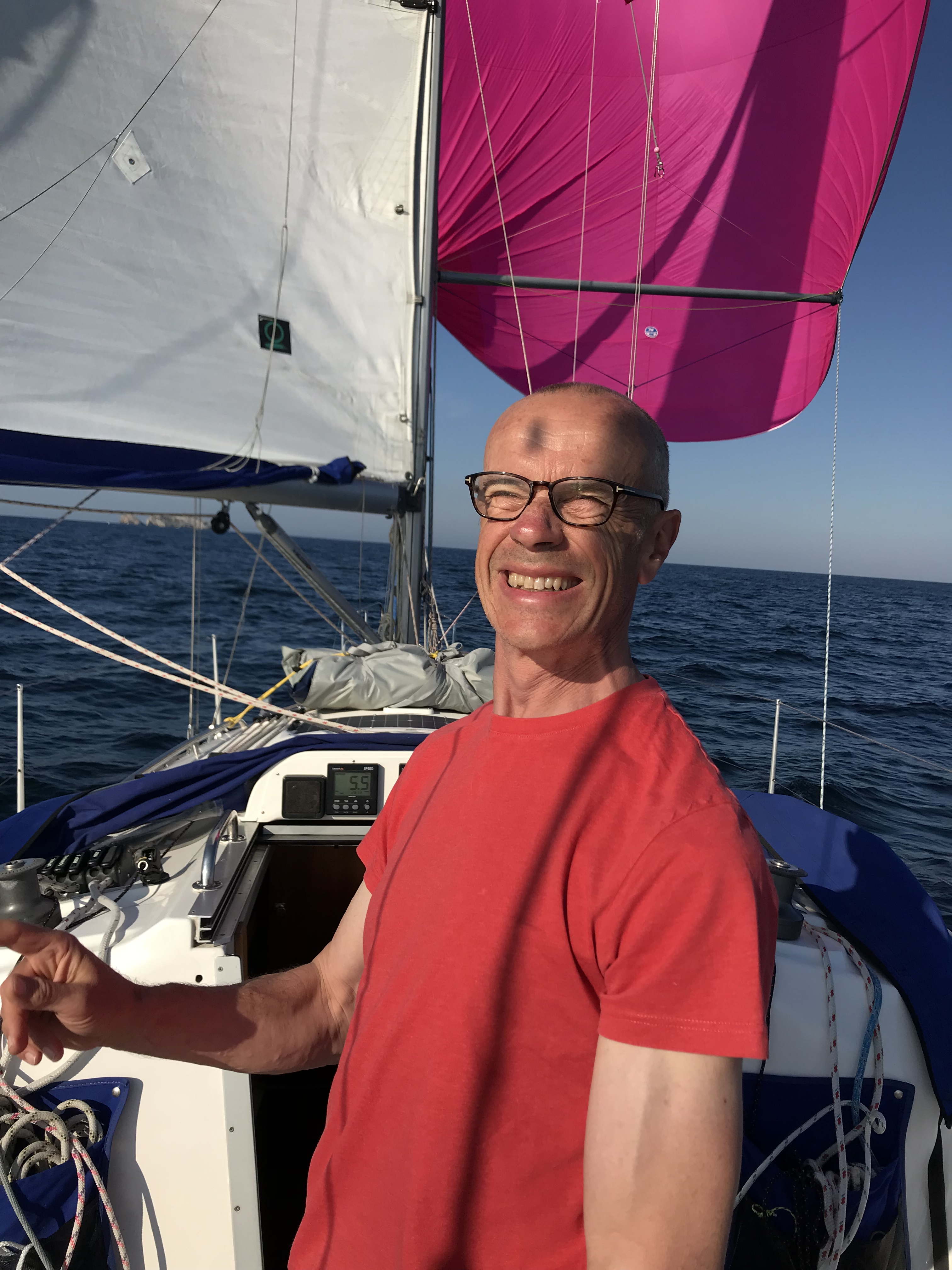
I’ve tried to keep this blog fairly light-hearted, so this will be a short post for two reasons: one, the episode it describes wasn’t that funny, especially not at the time; and two, there wasn’t much sailing involved. But nothing bad happened, except in due course I expect to my wallet. Intrigued? It won’t take long to get to the point, but first some vaguely relevant back story.
One of the reasons I have spent so much time in the far northwest is that I was planning to be somewhere else: I had lined up a suitably experienced (i.e. much more than me) guest to join me for a spell in the Outer Hebrides in the hope that we might have a go at St Kilda, a group of tiny islands in the middle of the Atlantic, or more precisely 50+ miles west of the nearest safe-ish harbours on Harris and North Uist, hence the need for a suitable guest. However, the guest in question turned out to be less suitable on the diary management front, so I had been left on my own these last few weeks, and whilst a possible St Kilda weather window had sort of offered itself, I decided that sailing at least ten hours a day on my own for seven straight days on half a promise of visiting an uninhabited bird colony was not my thing, and had addressed myself to the mainland instead.
Hurrah then for a guest more in control of his own diary in the shape of Andrew Penman, who had long expressed a desire to sail north of Skye, so we had taken this opportunity to line up a tour that would include excellent sailing, moderate hill-walking, famous-garden-visiting and one or two remote coastal pubs, ending up back in Arisaig where I had booked a mooring while I went home for someone else’s birthday. I had duly done the monster Tesco shop (quite hard, Ullapool Tesco is not monster), topped up fuel and water and was all ready to leave the instant Andrew arrived at 1630. By 1730 we were motoring down Loch Broom in a flat calm admiring the remote but rather glam holiday homes and then the Summer Isles and then the array of mountains in the setting sun, chatting through our week ahead with keen anticipation.
By 1900 we were past the last of the islands and I popped downstairs to get dinner ready. Shock, horror. One of the things you hope only to read about in Yachting Monthly had occurred: there was a whole heap of water sloshing about in the bottom of the boat. Even non-sailors will spot that this is a pretty bad situation: unless your fresh water tank has broken this means it is the sea coming in, and once it has started it tends not to stop until you intervene. This water was salty and laced with oil, so it was coming from outside and intervention was required, possibly quite quickly.
I’m pleased to say that if either of us was panicking we hid it well: Andrew got lively with the bilge pump while I sponged and bucketed and in a matter of minutes the water was back where it belonged; it had mostly been in the engine compartment and only just starting to run through into the saloon. Thank goodness for my legendary appetite: if I had had a larger lunch or breakfast it might have been another hour before I thought about supper. It didn’t take long to identify the leak: the seal on the prop shaft, which I had had replaced only two summers ago, was leaking steadily. We put the engine into neutral and the leak slowed but didn’t stop; we tried motoring again and the leak increased, so we stopped and assessed the situation. I reminded myself and Andrew of my observation a couple of blog posts ago: there are almost no yacht facilities in this part of the world, and indeed the nearest boatyard that wasn’t a specialist hand-crafted wooden boat builder (of which there are two famous ones locally) was in fact Arisaig, our eventual destination, 86 miles away. It was blowing all of five knots and forecast to decrease; at our current speed of three knots it would take two days to get there, if we were lucky. If the leak got worse we’d be in trouble, and if we tried to hurry by motoring we would make it worse.
Then I remembered that I had seen a small boat lift in Lochinver. It was 20 miles in the wrong direction, and directly upwind which meant that our VMG (remember that term? Our effective speed tacking into the wind) would be 1.5 knots, but even our slightly panicked brains could work out that we might get there by lunchtime tomorrow. Andrew demonstrated his internet skills by reading to the bottom of the page that I had discarded and found three phone numbers for various people in various positions of harbour authority, and I phoned them all, leaving increasingly garbled but urgent messages. We debated calling up the Coastguard but decided that with the water coming in at a manageable rate we would measure it every hour and as long as it got no worse we had a workable plan, so we came onto the wind and started beating north very slowly. I went down below again and put the venison burgers on the stove.
Our plan was confirmed as workable when a man I now know to be David Seddon, head of all the Highland Council Harbours (hurrah, the harbours are still owned by the state not some greedy commercial company where they don’t listen to voicemail out of hours), who assured me that they did indeed have a boat lift and whilst he couldn’t guarantee a lift next day we would be safe there. Were we sure we didn’t want to call the Coastguard? We promised we would if the leak got worse and pressed on. Half an hour later we were called by Joe, his deputy. He wasn’t the Harbourmaster either but was based at Lochinver and would make sure the team would pull us out as soon as the tide was high enough in the afternoon. They’d be waiting for us on the pontoons, there were a couple of locals who could do prop seals, they would send out a boat to tow us in if we didn’t want to start the engine, and were we sure we didn’t want to call the Coastguard? The lifeboat would come and tow us all the way if we asked… we quickly reassured him that we didn’t need to trouble the lifeboat, and promised again to monitor the leak scientifically, which we did with a plastic bowl and a marker pen.
By now the venison burgers were rather too well done, but rarely has Tesco venison tasted so good, knowing that our likelihood of sinking had just dramatically reduced. I love sailing at night, Andrew it turns out doesn’t, but luckily he found himself so far north that it never really got dark as we took watches, taking turns to creep along at between one and three knots in a failing breeze, with only one fishing boat and a minke whale for company on the whole horizon. The biggest hazard of night sailing here is not the ship-dodging of the Channel, it’s nodding off from having nothing to do and sailing into a rock or lighthouse by mistake. This was easily avoided by the wind gradually swinging into the northwest, and Andrew had played to another strength by consulting the weather apps and predicting this, so we were in the right place to ease sheets and start pointing at Lochinver without tacking, and were ghosting up the loch by 0400. Then the wind died completely, and since I didn’t want to drift onto a rock I put the engine on for the last 20 minutes, and by 0500 we were tied up on the exact pontoon I had let go of a little under 48 hours ago. I went to check on the leak and we had taken on more water in that 20 minutes than the whole night sailing; we had made the right decision to come to the closest possible port before the wind died.
My third, unplanned, visit to Lochinver felt like coming home: both Joe and David phoned to check we were OK, and we crashed out exhausted. I went along to the harbour office where Linda who had shown me around the village on her map three weeks ago now welcomed me like a prodigal son and told me ‘the boys’ would be down at two to measure up for the lift at four, so we went back to sleep. I managed to find someone in Cornwall who would send a new seal immediately; Linda warned me that ‘next day’ couriers were worthless up here and we should use Royal Mail; Sarah in Penryn ran to the post office to make the Special Delivery deadline. At two o’clock Mark the Harbourmaster, clearly delighted to be doing something more nautical than mending toilet seats, was on the dock with Scott the lift driver, who was clearly excited to be doing something more nautical than mending electricity sockets. Kenny the third man was stuck with the not-so-nautical forklift. The boat lift was identical to the one in Emsworth so Blue Moon knew her way onto it without any dramas, and only her owner screwed up by leaving the engine on as they drove her up the slipway, but that gave him a chance to show that he can replace the raw water impeller without outside assistance (let’s see if it works).
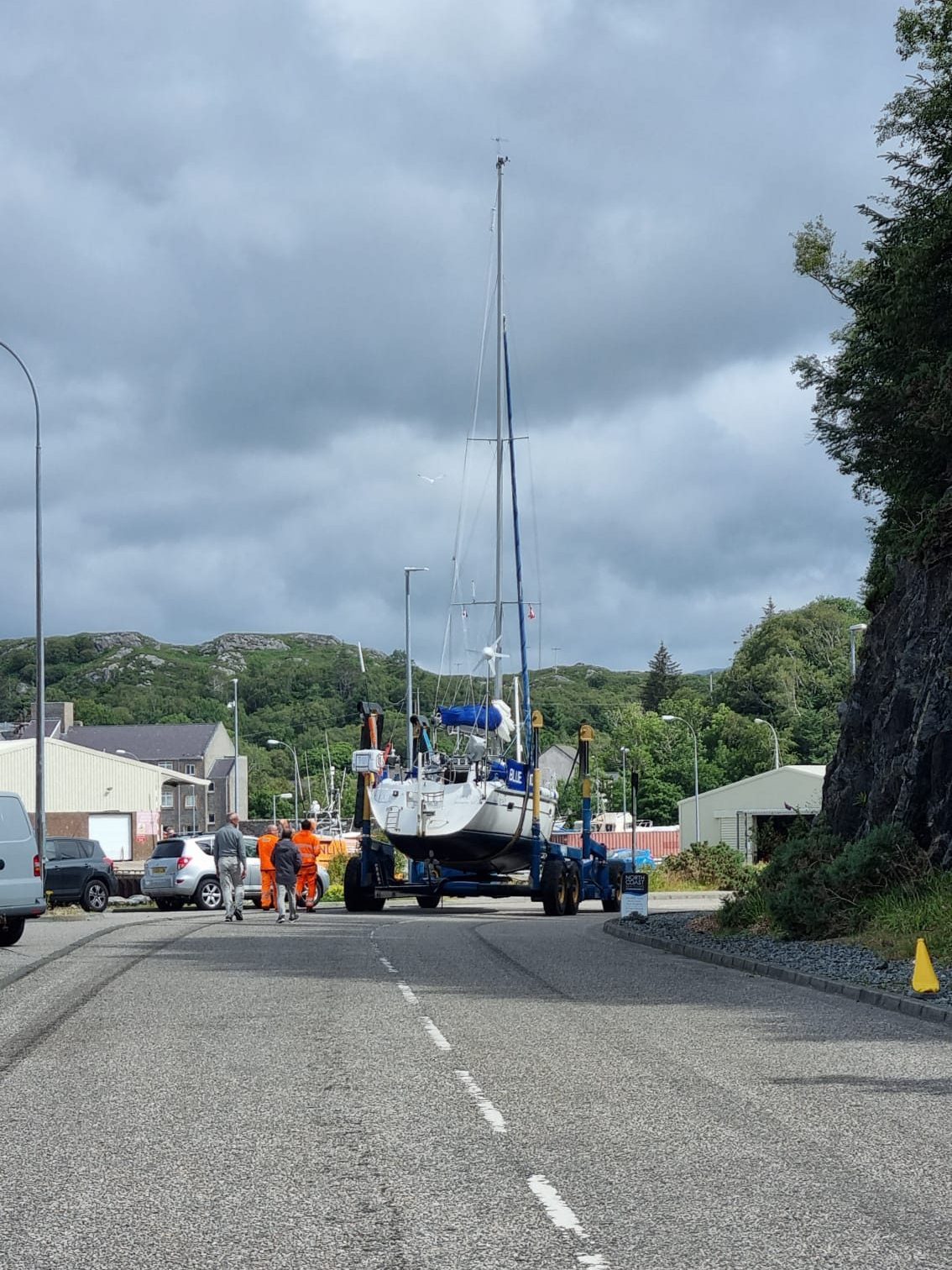
By four the boat was chocked up as firmly as if she was in a full-time marina yard and David the village engineer and lifeboat coxswain was lined up to do the work when the seal arrived.
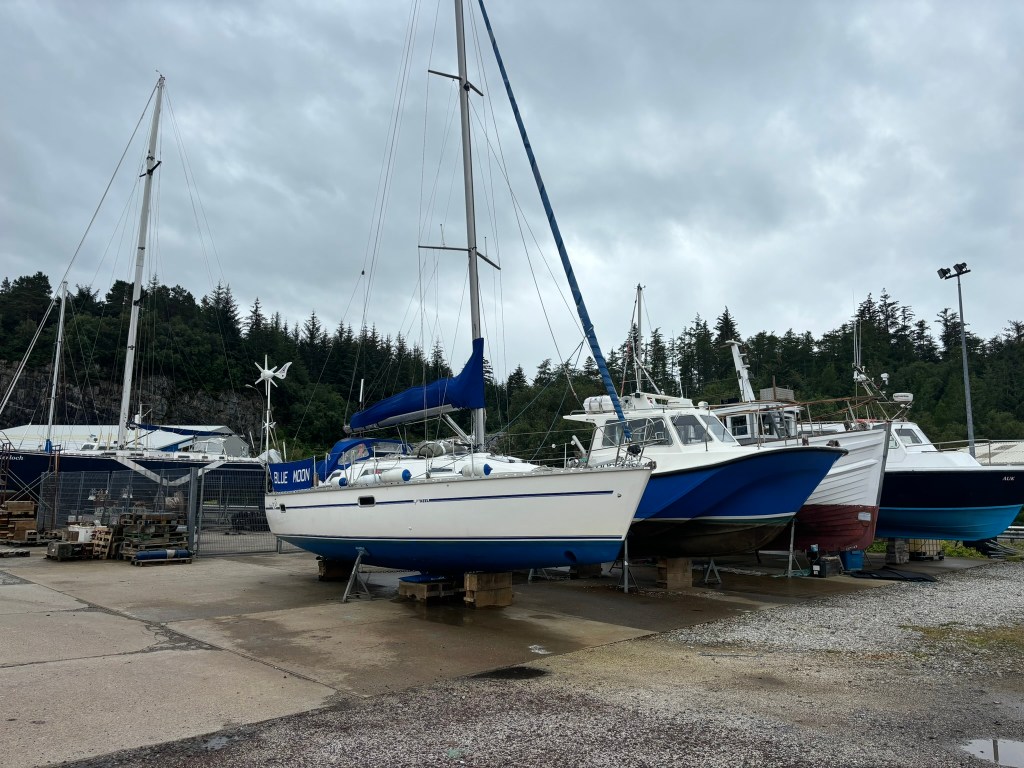
Next day David the boss of all the harbours came by to check we were OK; he turned out to be a keen sailor and wanted to hear the story. Then David the engineer arrived and took out the prop shaft – the old seal had a nick in it and the consensus was that reversing over the dinghy painter was the likely cause: apparently if you’re very unlucky the bits can get sucked into the seal. I decided not to mention that no-one told me that you were supposed to grease these ‘no maintenance’ seals every six months or so. He was interested to hear our tale as well, especially the bit about being encouraged to call the lifeboat. “That was Joe?” he enquired. “Makes sense. I’m off duty this week and he’s the deputy coxswain. He’d have been keen on a chance for a nice calm yacht tow while I was off.”
To our astonishment, despite being in one of those postcodes labelled as ‘all bets off’ at the bottom of every online retailer’s website, the Lochinver postie turned up at five, David finished his tea at six and by seven we had a brand new propshaft seal. “That’s you” said David, which was already probably my favourite Scottish phrase. “It better had be,” I quipped, “because if it leaks again it’ll be you that comes to get us”. Taking this as a pretty decent guarantee, Andy and I headed across the carpark to the grim hotel bar, where we sat looking back across the carpark at the boat, drinking beers neither of us had seen for about 30 years (remember McEwan’s 80/-?) and eating pub food from the ‘80s. This was about as far removed as possible from the week of glam sailing, hill walking and gastro pubbing that I had so carefully planned, but somehow the sense of relief combined with self-awarded gold stars for crisis management, whilst not making up for it, did at least mitigate the disappointment.
Deciding that neither of our lives would be enhanced by spending the rest of the week camping on a boat in a carpark at the back of a fish warehouse in a small village that one of us had already visited for four days, we took the opportunity to go home early. Lochinver is never going to be a popular crew-change destination for Londoners: I left on the 0743 bus and arrived home at 2230 that evening, after a fairly detailed tour of the Highlands and – yet again – both Ullapool and Inverness.
On the way, I reflected on the extraordinary nature of chance. If Tom (I can name him now that good has come of it) hadn’t bailed out on the St Kilda trip we would quite possibly have discovered a leaking prop shaft seal while anchored in Church Bay, 55 miles from the nearest safe harbour which itself is 65 miles from the nearest yacht lift. It would have turned a crisis into a drama, to paraphrase those excellent ads from the ‘90s.
PS To be fair to Lochinver, we did manage to eat one rather good if over-priced meal in an interesting community-owned restaurant-cum-local with amazing views down the loch. The second night in the hotel was desperation: I had bought days’ worth of food to cook on board, but we couldn’t face eating dinner in the cockpit sitting in a carpark next to a grim hotel and a giant fish dock warehouse.
Lochinver did also provide a morning’s stunning walking in country that didn’t involve climbing vertical mountains, just looking at them from different angles.

In the interests of saying thank you to the village I would encourage everyone to visit: there is an excellent butcher, a hardware shop that sells grease guns and boat fenders, several cafes, ceramics galleries to satisfy the most demanding NC500 campervanner, a hotel with an Albert Roux dining room, two good local restaurants and an award-winning pie shop. Be warned though: most of them shut at 1630. And who needs more than two buses a day?
PPS to be fair to Andrew, and I rarely am in public, he swapped a longed-for week exploring what we now consider to be the UK’s finest sailing and walking country for a hated night passage followed by a day and a half of watching emergency boat maintenance followed by a day-long journey home involving three buses without so much as a complaint, and I am very grateful that I had his sensible engineering-trained brain on board to sense check my crisis mitigation strategies.
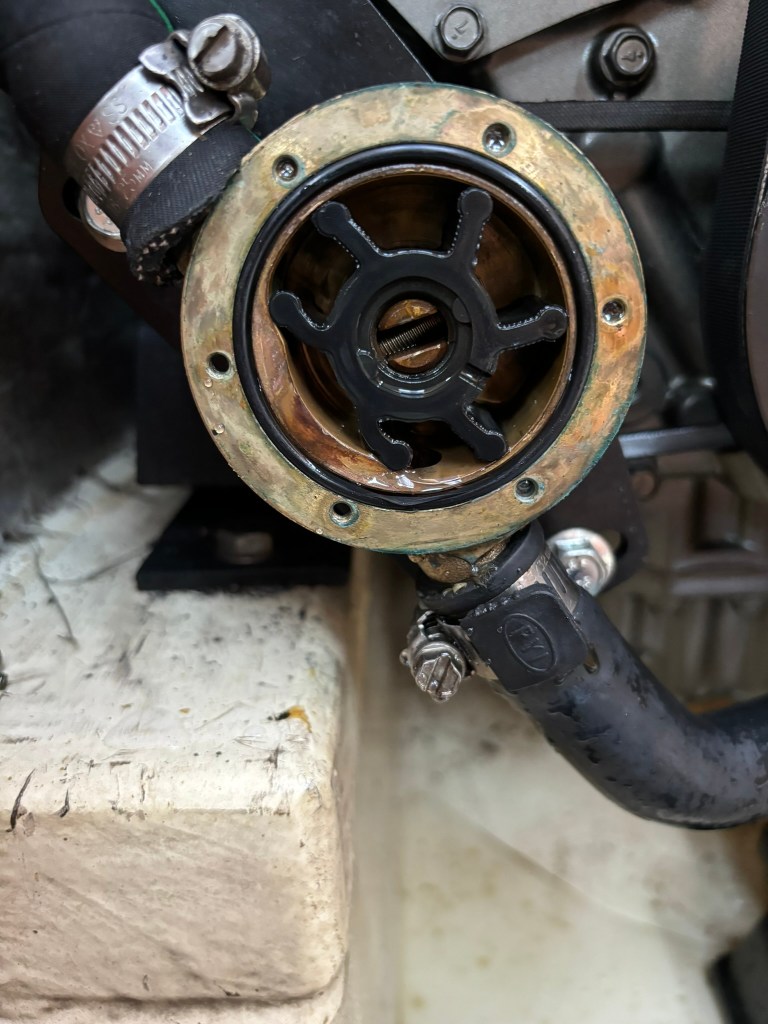
PPPS In the absence of a route map (I was a bit preoccupied and didn’t press the button on the recording app) here is a picture of what a shagged raw water pump impeller looks like if some idiot runs it for a few minutes with no water.



 Blue Moon's trip around the UK
Leave a reply to John Cancel reply