

The Summer Isles is another name to conjure with, and I’d been captivated since I first saw them on a chart. I pictured some kind of sailory nirvana where the sun always shone, the wind always blew 10 knots and the blessed few drifted from one isle to another enjoying barbecues and sundowners. Then Game of Thrones nicked this name too, which would have spoiled the image more if I had actually watched it, and The Wicker Man as well, but pretty much everywhere on the West Coast claims some association with that. Both of these sounded rather gloomy, and discovering that they are an archipelago at the mouth of Loch Broom just down from Ullapool suggested that my semi-Caribbean image was all wrong anyway. Nonetheless I was intrigued to see which side of this split personality they would actually present, and you will not be the least surprised by now, given that we are in Scotland, to find that the answer is both.
I had actually planned a lazy summer’s week, not just in the Summer Isles but moseying around the extraordinary range of lochs and bays in this part of the world. Although the coast is rugged and rocky there are countless hideaways large and small which unsurprisingly get progressively more remote as you head north. It also looked as if the mountains might start being a bit further from the coast too, so things might not be quite so gusty.
That plan did not survive past Monday, when I arrived windswept in Lochinver and fell to chatting with the nice couple who’d warned me about gusts. They were clearly on top of their meteorology both ancient and modern, because after the gust conversation they followed up with “Have you seen the outlook on PredictWind? We were planning to head up to Cape Wrath but we’re staying tied up here for a few days longer.” I had noticed that there was a possibility of stronger winds at the weekend, but since I was planning to be tied up in Ullapool by then and heading home for a birthday party I hadn’t paid much attention. Now I looked and they were right – all the wind apps had gone purple from Thursday onwards, and some were promising winds of 50 knots. This would not be good, and scarred by my no-room-at-the-inn Tobermory experience I was emailing the Harbourmaster at Ullapool within the hour and had booked what I expected to be the last space from Wednesday evening onwards. This was a shame, with only two days sailing left my plans were massively curtailed but I reckoned I would still have time to have a little explore of the Summer Isles at least, which would be handy in case the bad weather came earlier since I could be in Ullapool from there in a couple of hours.
I was determined to make the most of Lochinver though, having come this far north. Its main attraction was the showers, but I was delayed from jumping straight in by the friendly couple who, having realised that the first of their six weeks’ holiday was going to be spent on their pontoon, seemed to be in no hurry at all to stop talking to me. This was all part of the fun, I thought, and they were delighted to discover that their boat – a Twister, for those in the know, who will already be very appreciative because Twisters are proper East Coast classics – was built half a mile from my childhood home at Tyler’s yard in Hoo, where we walked the dog after school most days. It was quite the best kept example I have ever seen, and I do make a point of checking Twisters out if ever I see one.

Eventually I took my leave and went to find the Harbourmaster and the showers, and this was when I discovered that Lochinver is pretty much the opposite of Shieldaig in that it is a very down-to-earth working village, playing host to a big fishing fleet and a huge fish warehouse thing where all day and much of the night fishing boats come in on one side and refrigerated trucks line up on the other. Given the speed with which the fish seemed to make it from boat to truck I couldn’t see the point of the warehouse, other than making the Harbour Office seem more impressive as it – and the showers – were a good ten minutes’ walk away at the far end. The good news was that this deterred the campervans, all of whom were at the far end of the village; the bad news was that the facilities definitely catered to refrigerated truck drivers not yachtsmen. The very welcoming woman in the office pointed out a door at the end of the corridor and assured me that the shower in the gents behind it would be lovely as it had just been replaced. As if to prove her point there was a big Mira shower box on her desk, but rather oddly a brand new electric shower in the skip downstairs along with a toilet seat. Sure enough the shower that was on the wall and not in the skip or on her desk did work very nicely, although it felt a bit odd showering in what was clearly someone’s office lavatory, and there were signs in French and Spanish asking people to take care with the taps and the toilets. Notwithstanding the signs one of the toilet seats was broken, and I mentioned this to the Harbourmaster later in passing. He rolled his eyes. “That’s the sixth this year so far”, he sighed. “I’ve got some spares in the cupboard, I’ll go and fix it now.” I must have looked surprised as he went on, “You should see the size of some of these European lads. The have only to look at a standard toilet seat for it to snap.” I wondered how many showers they were expecting to get through.
Following this fascinating insight into the varied life of a Harbourmaster, I set out to explore the village and found two very different sides. On the one hand, the well-kept but very ordinary cottages were clearly those of fishing and harbour folk and their families, with no sign of the holiday lets or even B&Bs that characterise every other West Coast village; on the other three restaurants, a deli/café selling award-winning pies and a smokehouse clearly catered to the NC500 crowd, but without a campsite with electricity most of them moved on during the afternoon, and I enjoyed a quiet walk through the woods behind and around the shoreline, where large waves were still crashing onto the beach – clearly no-one had told them I was out of harm’s way.
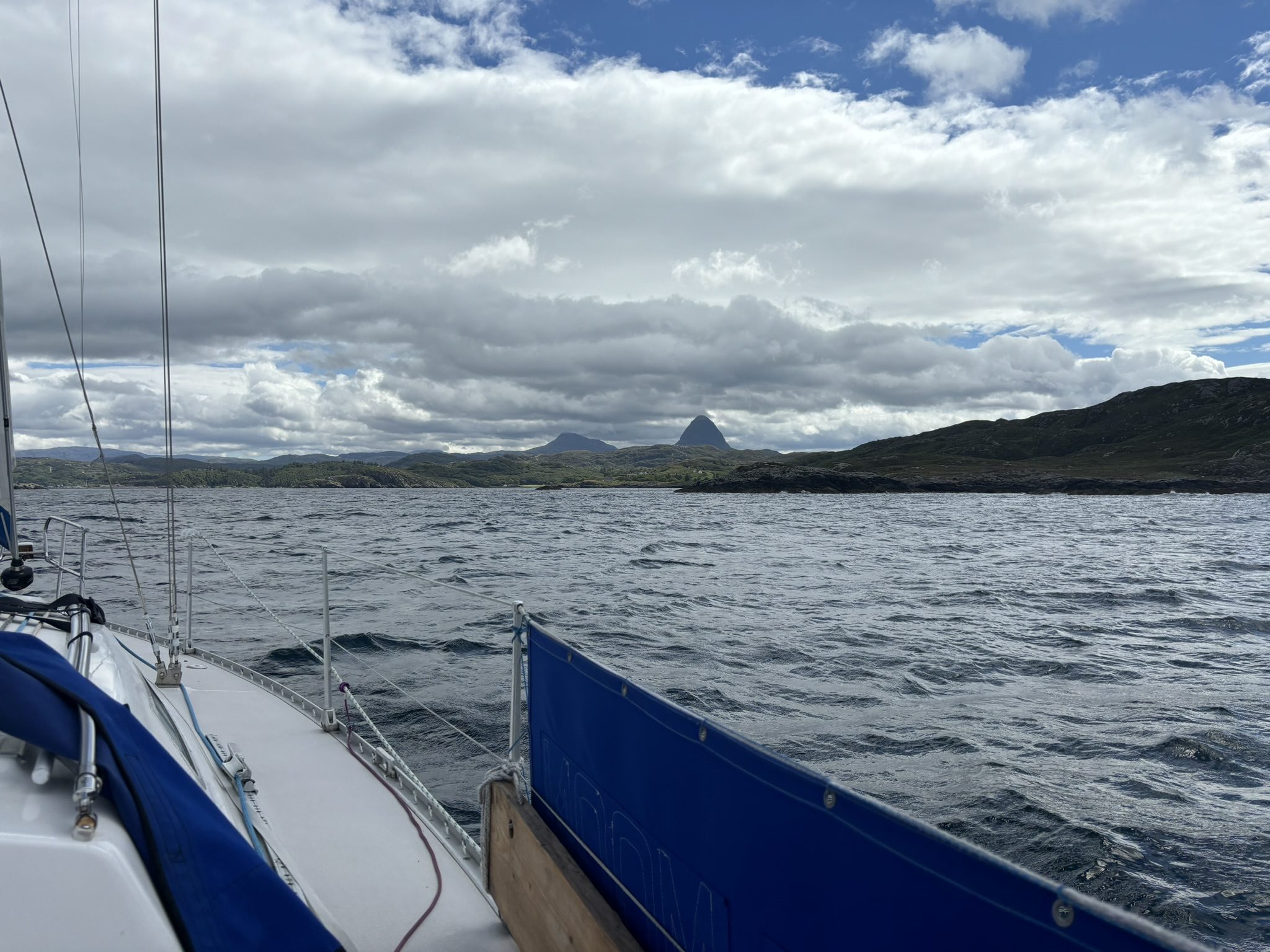
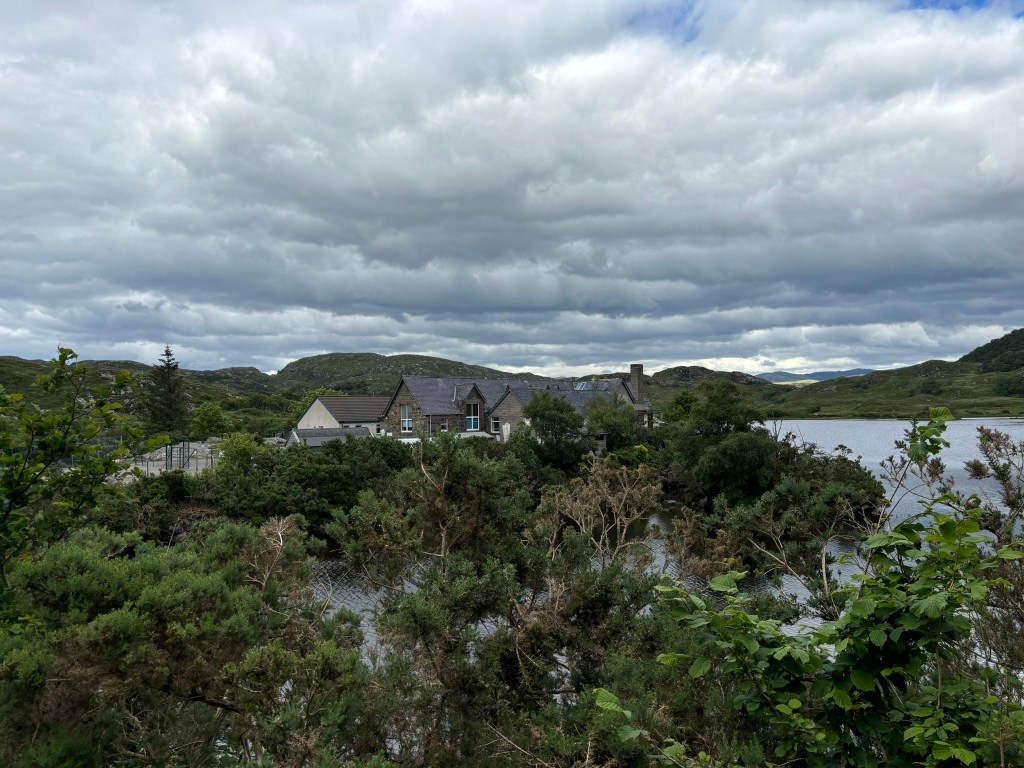

The dog has been waiting years for him to throw that ball
Time was against me if I was to get into Ullapool before the storm broke though, so next day I came up with what I still consider one of my most cunning of cunning plans: rather than missing out on the anchorages I had earmarked for a visit in my leisurely week, I would tick off more boxes by visiting more than one each day. Brilliant! And so it proved – I motored an hour round the corner from Lochinver and threaded my way through yet another ridiculously rock-strewn entrance to discover tiny Loch Roe, correctly described by the pilot books as being stunningly beautiful, very remote and totally sheltered, hidden up a sort of rocky valley round two corners from the open sea. It would have been a great place to spend the night, but given its remoteness I didn’t feel I’d missed much by just anchoring for a leisurely lunch before moving on. This did give me time to witness a shocking piece of bad tourism: a little tripper boat from Lochinver came in and made a beeline for the seals basking on the rocks near me. One of their passengers had brought a dog which started barking at the seals only yards away – I didn’t realise seals could move so fast on land but three or four terrified ones leapt around the rocks to get away from the dog, and the boat just followed them.

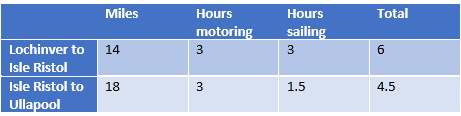
For the first time since leaving Portree there was not enough wind even to think about reefing, and most of the journey down to Loch Broom was either motoring or drifting gently, but with no time pressure I rather enjoyed the lack of stressful gusts. It did mean that it was nearly 1800 by the time I arrived at Isle Ristol, my chosen destination, which looked on the chart likely to be a deserted anchorage to rival Loch Roe. Not so…
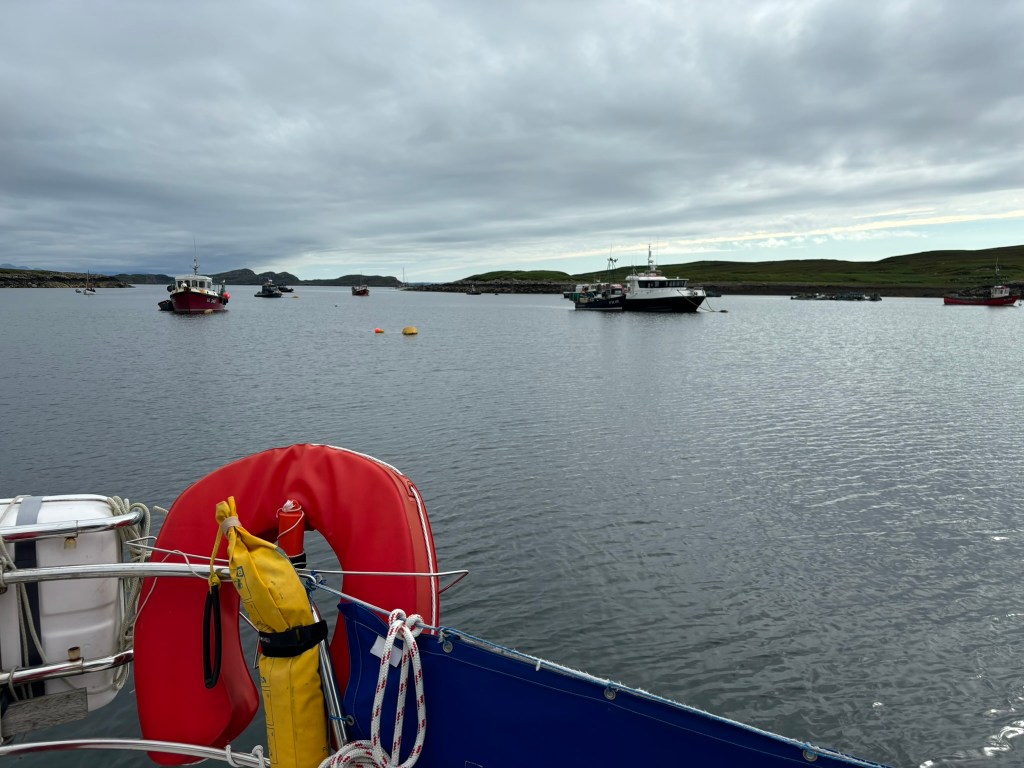
I arrived to find a tiny bay absolutely crammed with moorings for fishing boats, and a steady stream of boats arriving and picking them up. The recommended anchorage was right in the fairway outside the bay and I thought I really would be in their way, so began to wonder if I shouldn’t have to go somewhere else. I thought I’d potter through the moorings first, and found a bay at the top by the jetty they landed on which was going to have just over two metres of water at low tide – just the sort of place people with fixed keels would avoid. Better still, the water was so clear that I could see the bottom easily and picked a nice sandy spot to drop the anchor onto, clear of the fishing boats and totally sheltered.

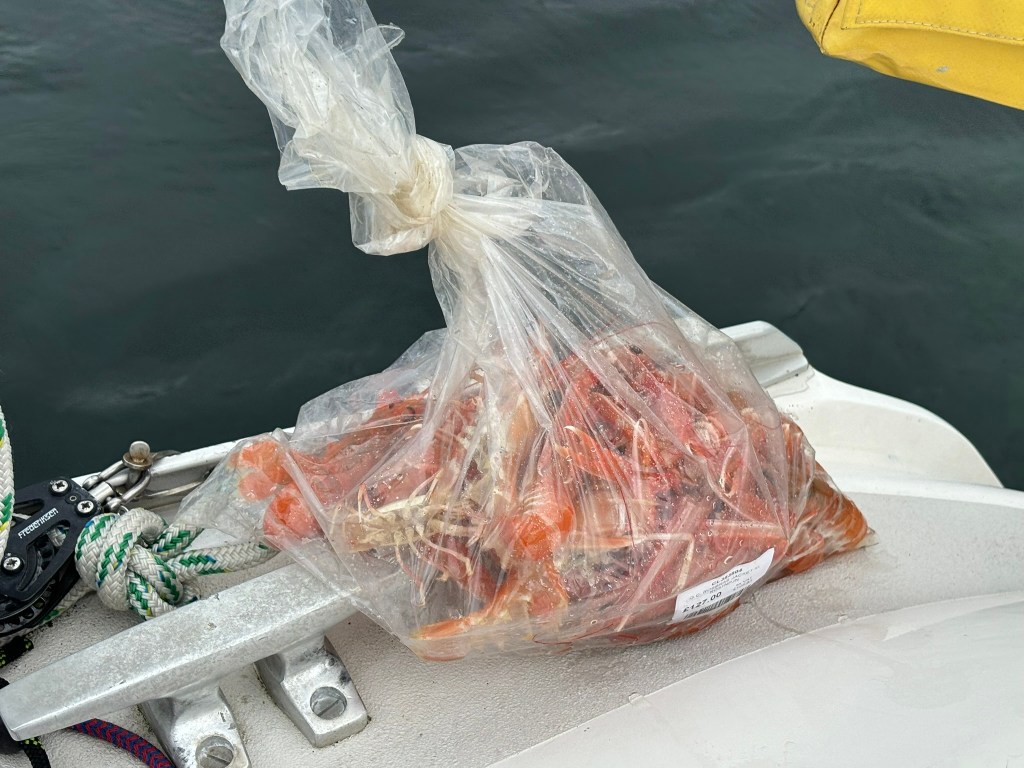
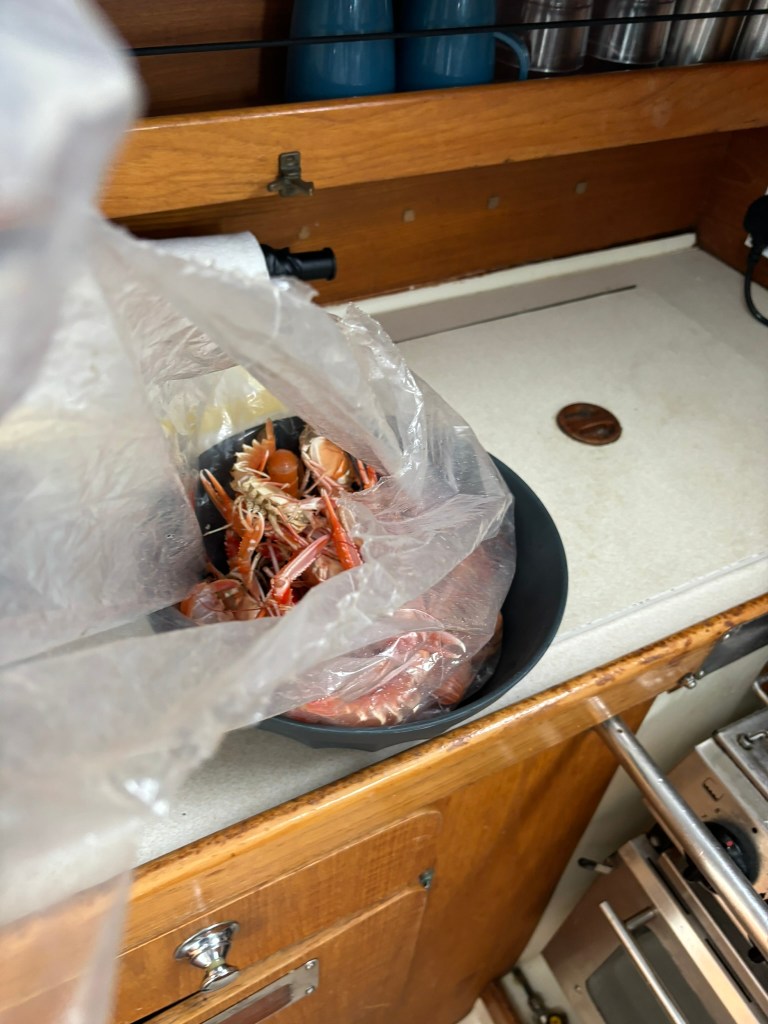
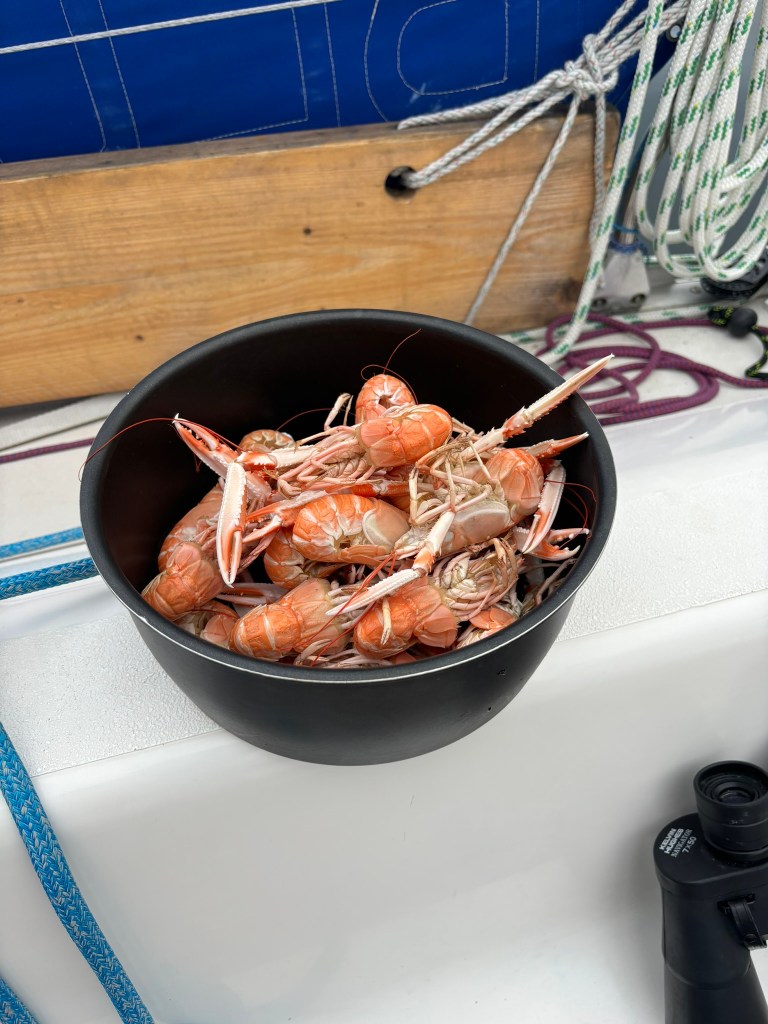
I did worry that I would still annoy the busy fishermen by being near their jetty but if anything they seemed to admire my seamanship, or perhaps just the chutzpah, as every one coming past on their way to land their catches gave me a cheery wave as I settled down in the cockpit to write the previous blog post. (In England fishermen never wave at yachts, they swear and shake their fists). Then it looked as if my luck would run out– a particularly gnarled old boat was heading towards me, then coming right alongside. I prepared for words as a particularly gnarled old fisherman stuck his head out of the window, but then his hand followed with a huge plastic bag full of langoustines he’d just caught. “Here’s a wee snack for ye” he growled (sorry, but that really is how he said it). I thanked him and tried very hard to pay but he wouldn’t have any of it. “Enjoy yer evenin’ noo” he called and headed off to the pier.
Now many readers will know that I have a lifelong fear of live crustacea, ever since a nasty encounter with a crab on the beach at Angmering aged four, so a bag of clearly very alive and very angry shellfish with claws was quite a challenge. Hurrah for YouTube, where various Scottish chefs cheerfully urged their viewers not to bother with any of this lulling to sleep nonsense reserved for proper lobsters, their baby cousins invariably went straight into the pot. So, conscious that the fisherman might see me if I chucked them away, and also that I love langoustines and he’d given me about £40-worth if I’d ordered them even in a local pub, I put my biggest saucepan on the stove and girded my murderous loins.
It wouldn’t have made the final cut of Annie Hall, only one escaped the bag and he was soon brought to heel, and within 20 minutes the gnashing mass had been transformed into a huge pot full of the freshest and tastiest shellfish supper – except of course that this is just how every pub and restaurant on the coast cooks them, just a few hours later on. Fun fact from the internet: Scotland produces a third of all the langoustines eaten in the world. None of those are as fresh as mine.

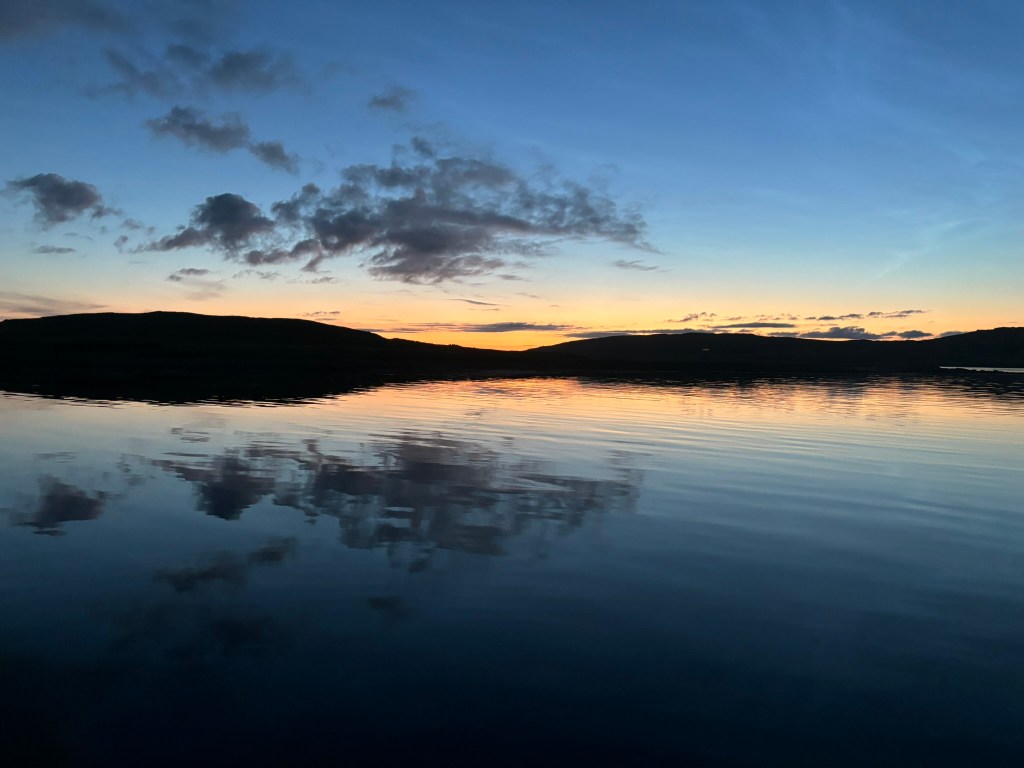
Isle Ristol is not technically a Summer Isle, being joined to the mainland at low tide, but given that it is all of a mile from various certified Summer Isles I think they’re being unnecessarily strict. I counted my night there as part of this brief Summer Idyll, since for the first time this trip there was a flat calm and a beautiful sunset, so it looked and felt exactly right.
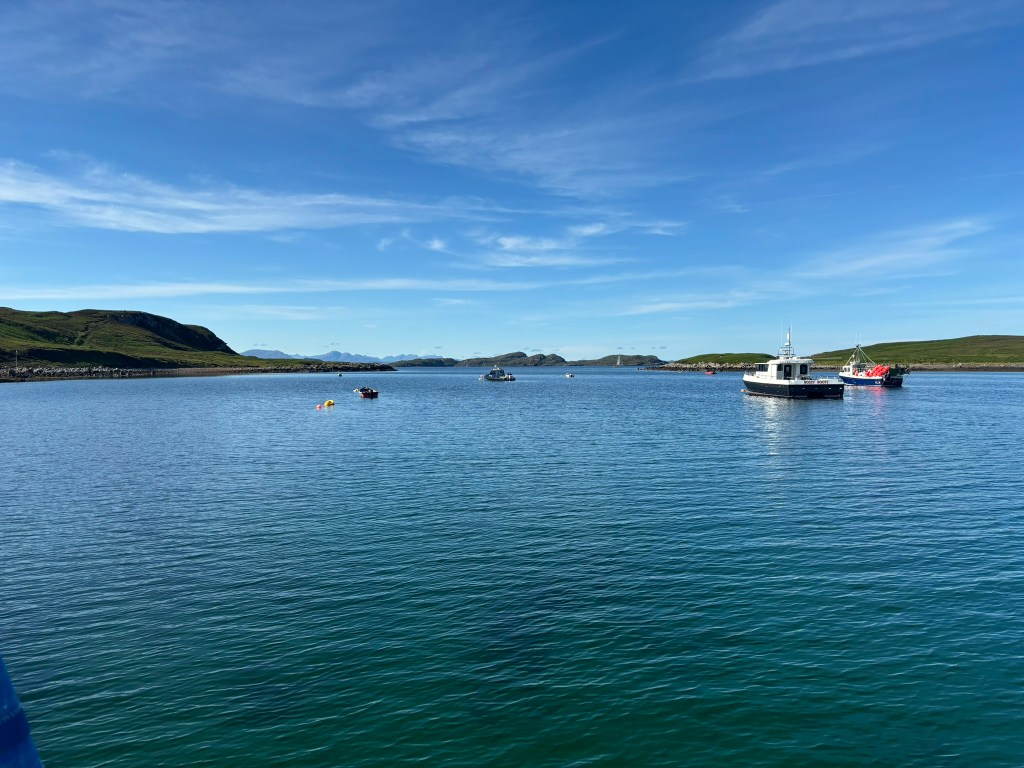
The lazy breakfast in the sun-drenched cockpit was just what I’d envisaged, and I planned to extend this Summer Idyll to as many Isles as possible by choosing different ones to anchor off for elevenses, lunch and tea before finally calling it a day and heading up to Ullapool. This plan seemed genius: the forecast was for no wind at all until the evening and I drifted the mile downwind to the gold star destination anchorage of Tanera Beg, where the islands create an almost enclosed lagoon to anchor in. I even considered donning shorts for the first time, although swimming would have been an act of madness.

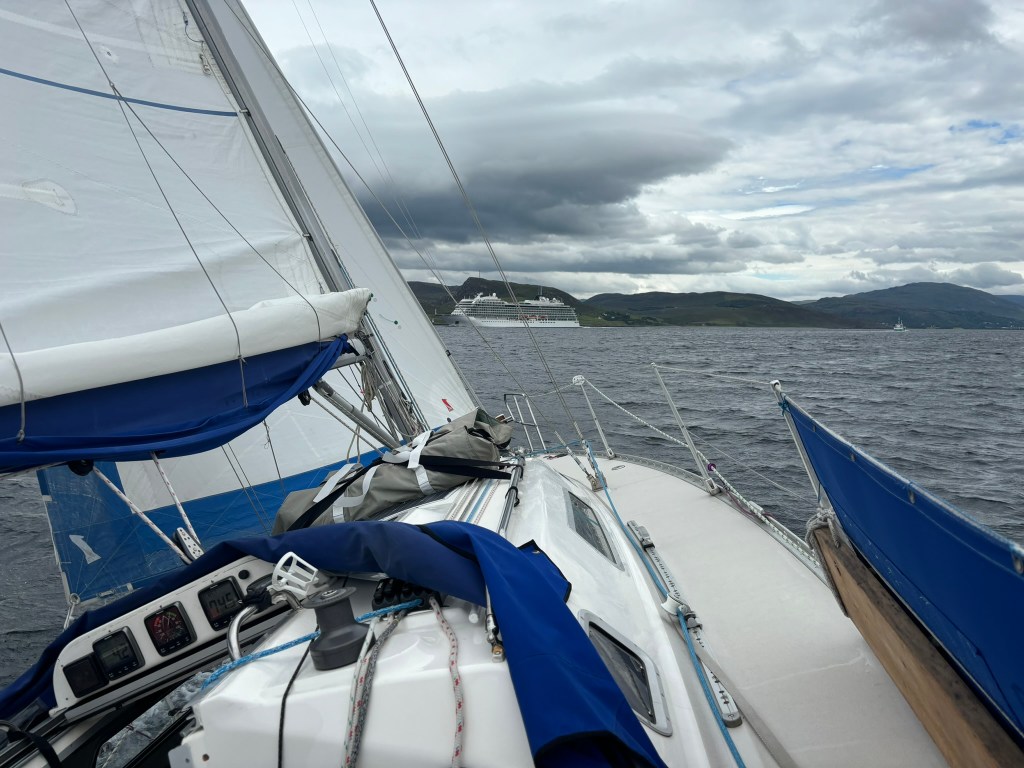
Coffee drunk I still had two more Summer Isles to go and a lot of motoring across a glassy loch to enjoy, so I headed out towards the interesting-sounding Priest Island. I rounded the corner and – quelle surprise! – found that in the hour I had been in the lagoon a 20-knot breeze had sprung up, completely un-forecast. Which direction? East! Which way to Ullapool? East! I could barely believe it. Heading off to any variously exposed island anchorages in these conditions would be downright perverse, so I reluctantly started heading upwind and – yet again – the wind continued to build until steadily in the mid-20s. Yet again I found myself heading up a loch with two reefs and a rolled genoa, this time before I’d even had lunch. This was not the drifting sunny idyll I’d had in mind, but the wind did eventually moderate a little and I started to enjoy a decent beat, especially when I could unroll the genoa, take a reef out of the main and make a sandwich. It was especially pleasing to note how quickly I was outstripping the yacht motoring up behind me, which was also reassuring as – in spite of my booking – I was expecting crowded pontoons and storm-driven yachts jostling for position.
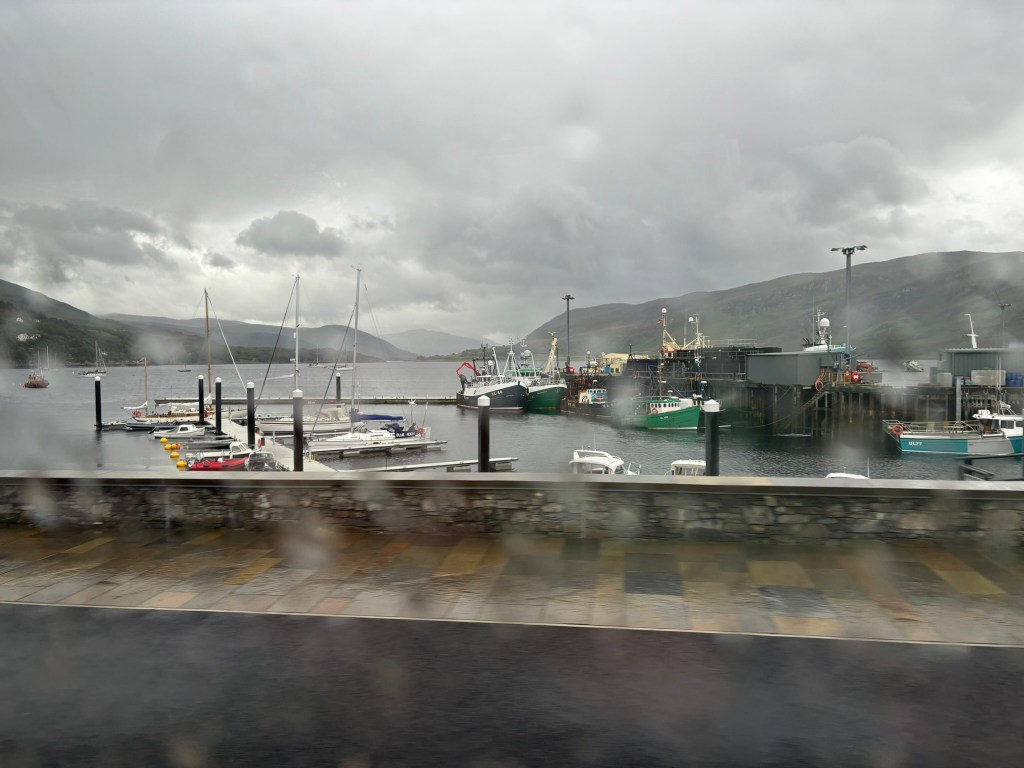
A call to the harbourmaster elicited the most detailed instructions on how to get to the pontoons (he could have just said ‘turn left at the breakwater and they’re right ahead of you’ but he described every fishing boat I would pass and on which side) and I followed them to the letter, to find the pontoons I had expected to be subject to a Tobermory-esque jam completely empty. They were brand new in April, and I had only been made aware of them a few weeks back by the Itchenor folk, along with the opportunity it presents to leave the boat this far north and head home. Clearly word hasn’t spread that far: the only visitors in a clearly forecast three-day gale were me and the boat who’d motored in, now an hour behind me, so I could pick my spot and make myself at home in the brand new and very smart mini-marina.
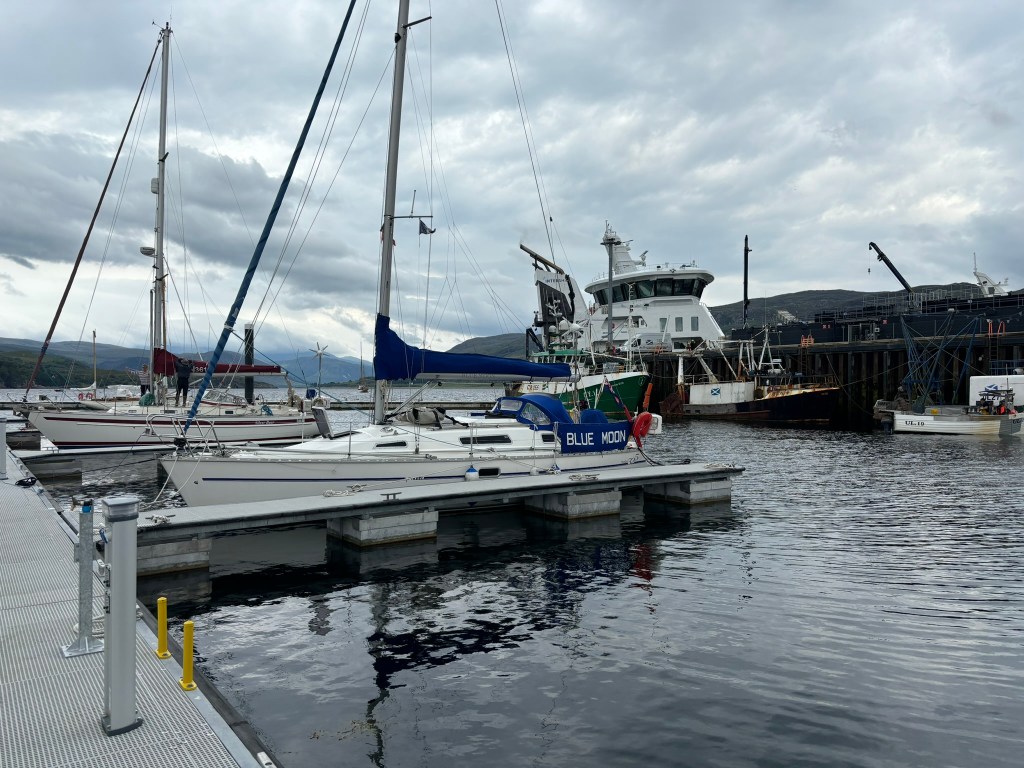
It duly came on to blow very hard indeed, and a day later started raining in a way that suggested it might never stop.
I had been very disappointed by my curtailed week but it had its compensations. These included:
- The first chance to take advantage of Philip’s regular forwarding of Guardian restaurant reviews by eating fabulous and ridiculously cheap oysters paired with a bizarre but excellent tempura haddock wrap at the oh-so-sustainable Seafood Shack https://www.theguardian.com/environment/article/2024/jun/25/served-up-from-the-sea-10-of-the-best-sustainable-eateries-on-the-british-coast
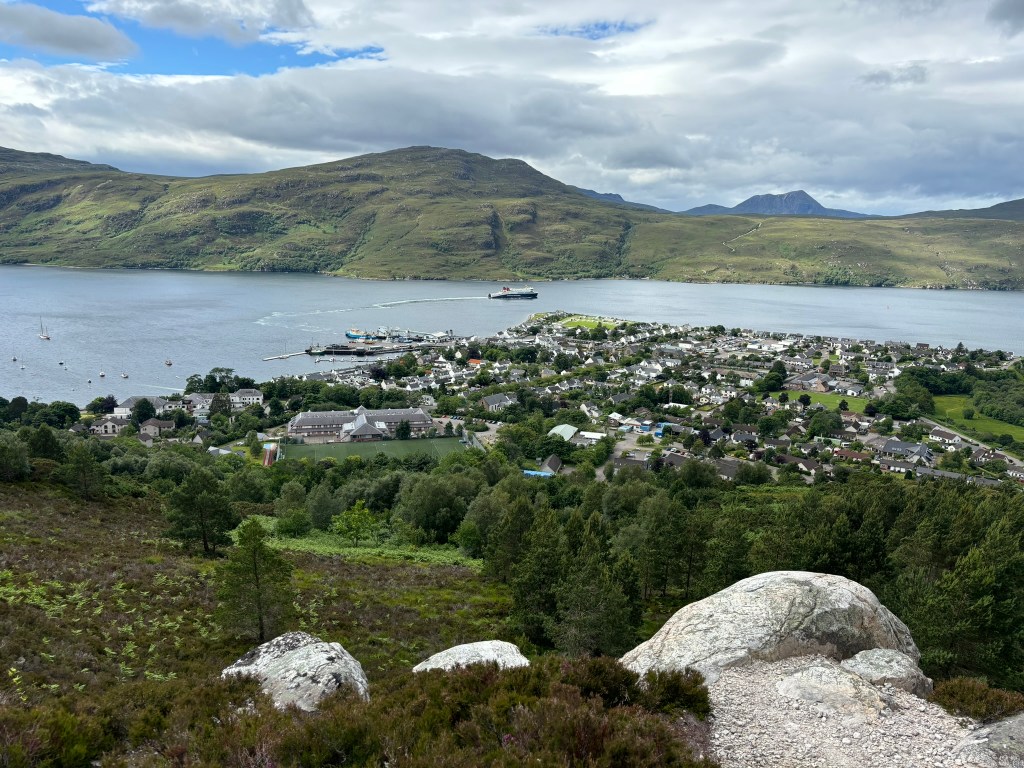
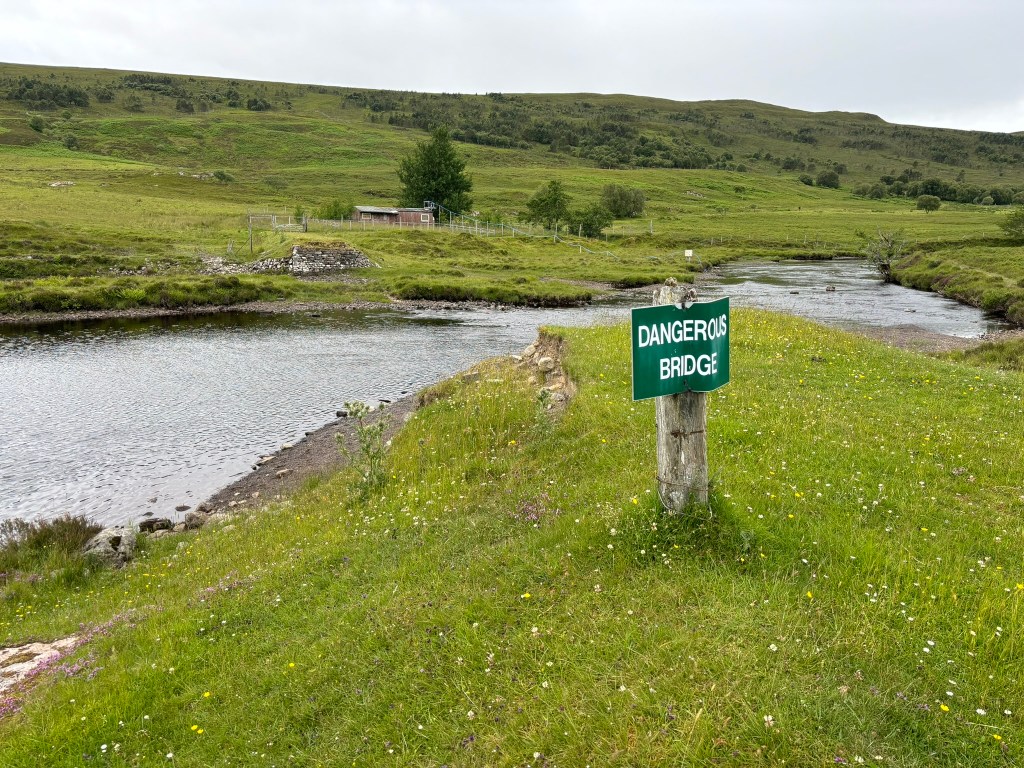
- A decent half-day hike up Ullapool Hill and on to a remote inland loch getting back just before the heavens opened
- A chance to meet a great group of kids from the Ullapool Sea Savers https://ullapoolseasavers.com/ who handed me a sticker and lectured me very politely on not getting too close to dolphins. They were entertained by my defence that the dolphins tended to get rather too close to me without being asked, and agreed that sailing boats weren’t really the problem they were campaigning against but were more likely to accept the stickers. I decided not to spoil their day by telling them about the dog and the seals.
- Best of all, faced with such a dismal and windy forecast, the chance to come home a day early, although litigation with Opodo seems likely to result. But given just how very wet, windy and cold Ullapool is compared even with Inverness (just over an hour away on the ferry express bus) it is worth every penny, knowing that while I am away the Summer Isles will still be stuck in what I would call a windy winter.



 Blue Moon's trip around the UK
Leave a reply to Kate Beswick Cancel reply