I’ve long fancied visiting Kirkcudbright, not that I knew anything about it at all, just that it has the most amazingly Scottish name, and I did (luckily) know that you pronounce it ‘Kiercoobree’. I was surprised – for instance – to read in all the pilot books that it is referred to (by the tourist board, someone helpfully suggested) as ‘The Artists’ Town’, having been colonised by the Glasgow School in the late 19th Century, and is consequently well-heeled and well-kept. This was all good, new knowledge; the slightlly disappointing discovery was that Kirkcudbright means nothing more exotic than ‘The Church of St Cuthbert’, which, now you say it, seems really obvious.
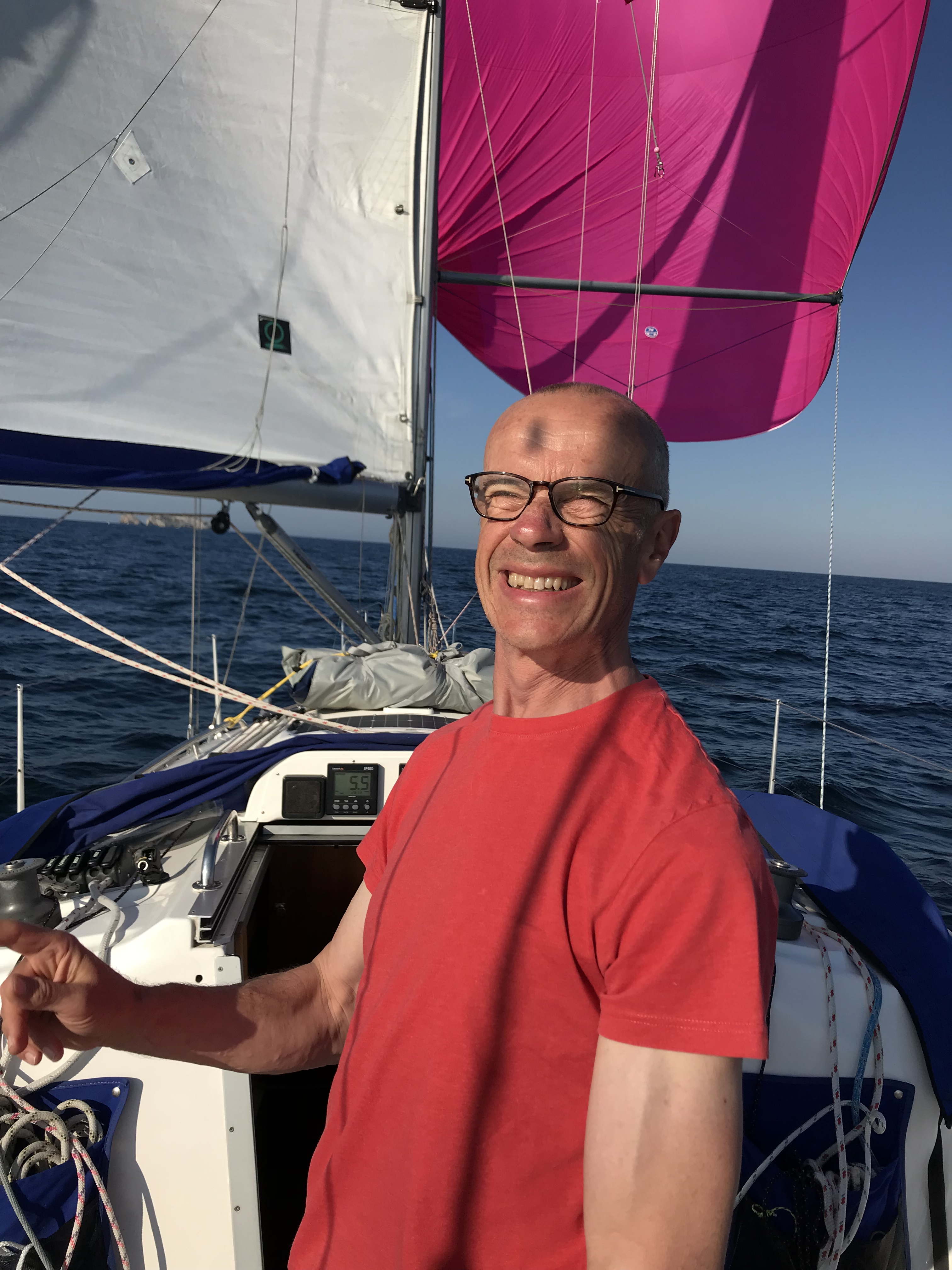
All of this discovery was ahead of me though as I squeaked out of Whitehaven Sea Lock as early as I could. This was not as early as I had hoped, since the beach has shifted towards the lock and the lock-keepers have had enough of yachts running aground in the middle of the harbour, A bit of arm-twisting and keel-lifting and I was out though, but only with enough time to get to Kirkcudbright (or KBT as its inhabitants call it, not quite as glam as ‘The Artists’ Town but quicker to type) if I motor-sailed. I really hate motor-sailing (which, for the unitiated, is putting your engine on while you’re sailing) but there’s no denying it makes you go faster. However, it also makes you feel like a fraud and a loser and an environmental hooligan, or it does me. But since it was the first time I had actually had the sails do anything useful this year (we were going 1.5 knots faster than either sails or engine alone) I sucked up the shame and cracked on.
Why the need for speed? You guessed – tide. My, how I am now looking forward to those rocky places up north where you can arrive at high or low water or anywhere in between. KBT is up a long, winding and very shallow river, and you’re advised to arrive while the tide is still coming in because it runs out at up to four knots and then if you’re late leaves you stranded on a mud bank. The problem being that I couldn’t get out of Whitehaven until four hours before High Water, which left me needing to do 6.5 knots to cover the 27 miles to KBT before I was washed back out again. I know you love all this yachty maths. I had phoned the helpful Harbourmaster the day before who, in trying to be helpful, had suggested that on the one hand I probably wouldn’t run aground if I lifted my keel up, but on the other I might take a long time and burn a lot diesel fighting against an ebb tide on account of the hydro-electric chaps upstream having had rather too much rain in the last 48 hours.
Luckily my cheating charlatan motor-sailing strategy worked a treat: I swanned up the really very attractive River Dee, managed to follow all the twists and turns of the channel and arrived off the town when – wham! – it was if somene had just pulled a plug out behind me. It was throttle down yet again, and this time just to ferryglide (remember that term? The HM rather patronisngly but well-intentionedly asked me if I did) alongside the pontoon. It was running so hard that where you landed was where you stayed: I tried to move forwards to make a bit more room but even with the engine running couldn’t pull the boat forwards against the current. I watched fascinated as the tide hosed out along with all the lovely bright brown rainwater for well over its allotted six hours, and then when it turned, rather than the flow going the other way, it simply stood still and rose up gently as the river cancelled out the flooding tide. Weird. And the lovely wide-in-places windy river became a sea of mud with a channel in a trough at the bottom. Being from the land of mud I shouldn’t have been so surprised, but I’m used to mud being flat: the Medway simply doesn’t have the vertical scale of the Kirkcudbright Dee.
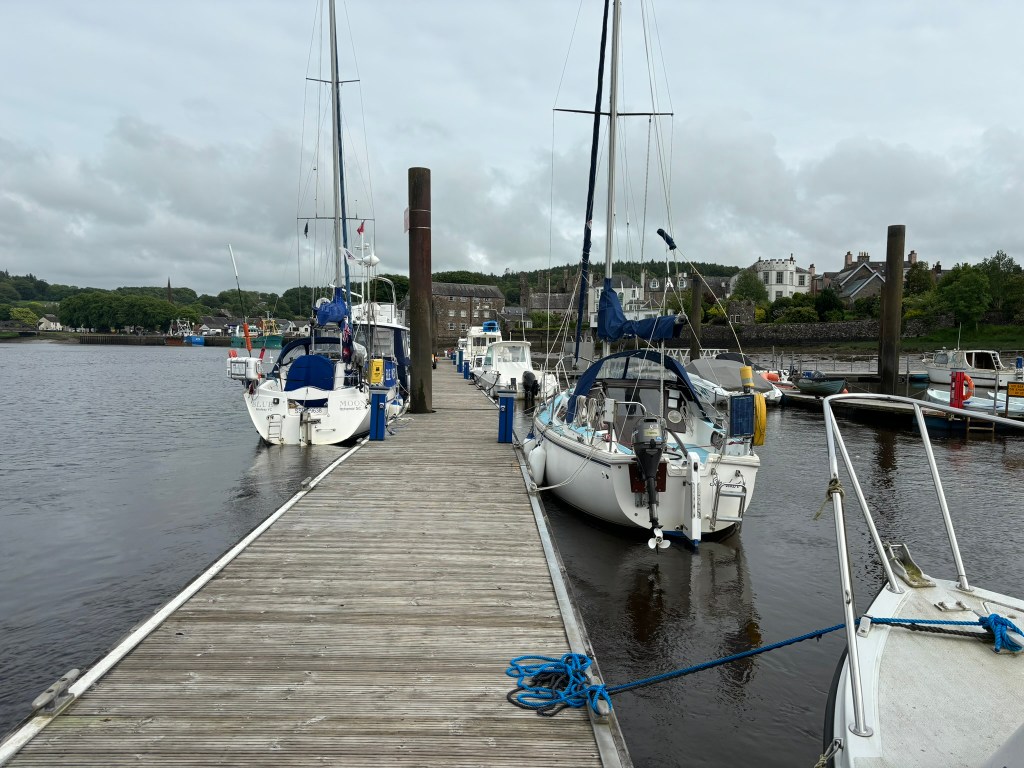
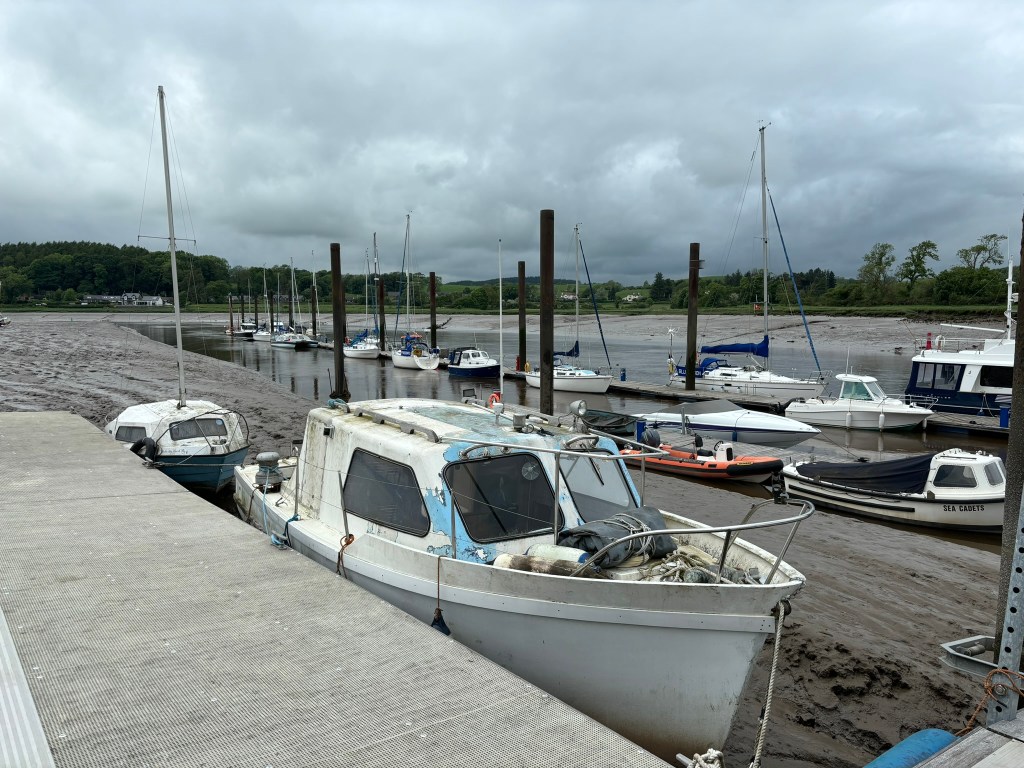
However, this was probably KBT’s only downside. The rest of it is one picture postcard after another, and that’s before you get on to the paintings. It has the Georgian streets that Whitehaven should have had:
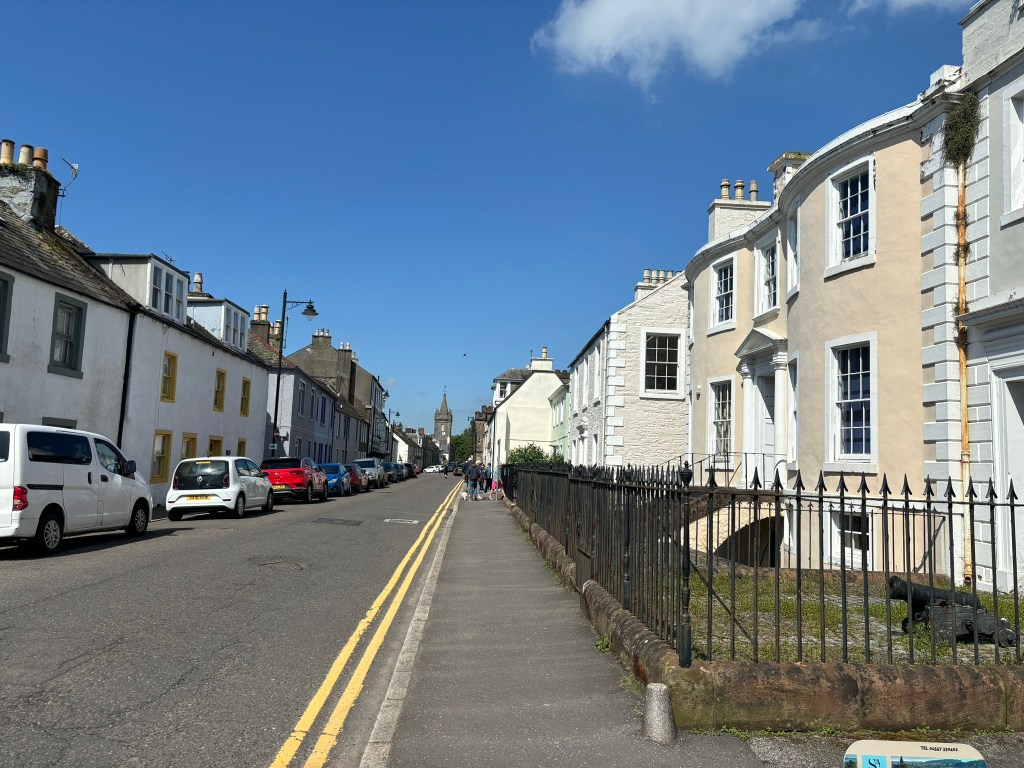
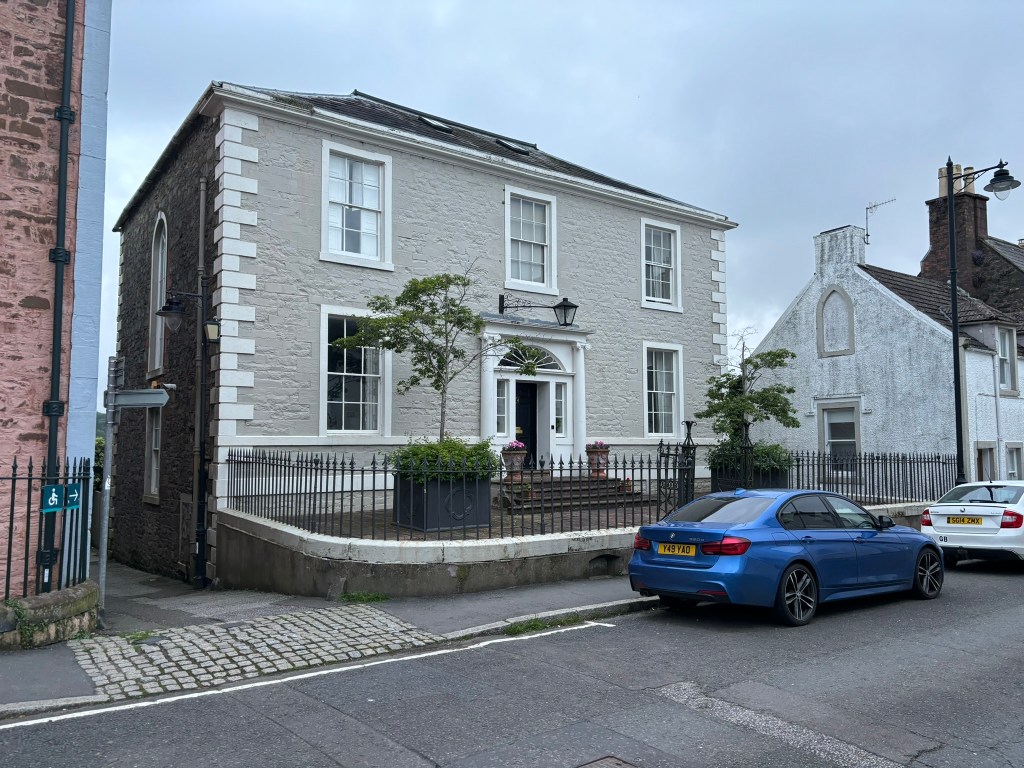

It has three churches, two museums, and more art galleries than you could possibly visit in one day. Forty-something I think. It has a ruined castle:

…a picture-perfect quay with actual fishing boats five miles up a river…
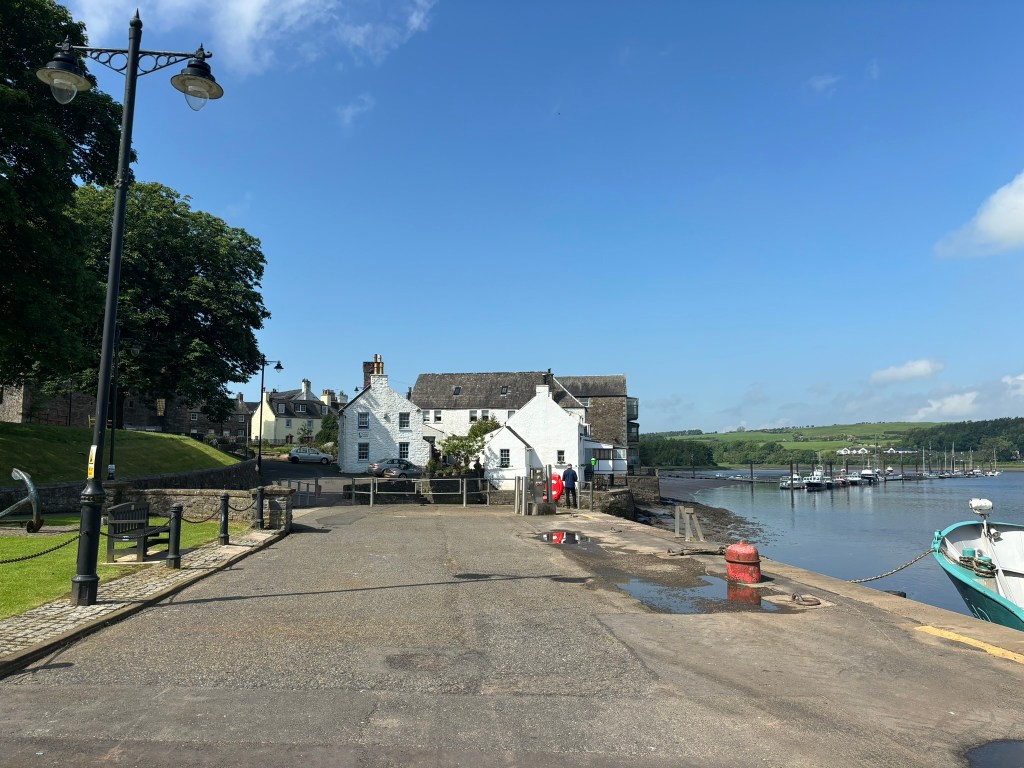
…and on that quay, about six yards from the boat that caught them, scallops cooked fresh by the much-raved-about-on-Google-reviews Skipper’s Scran Van:
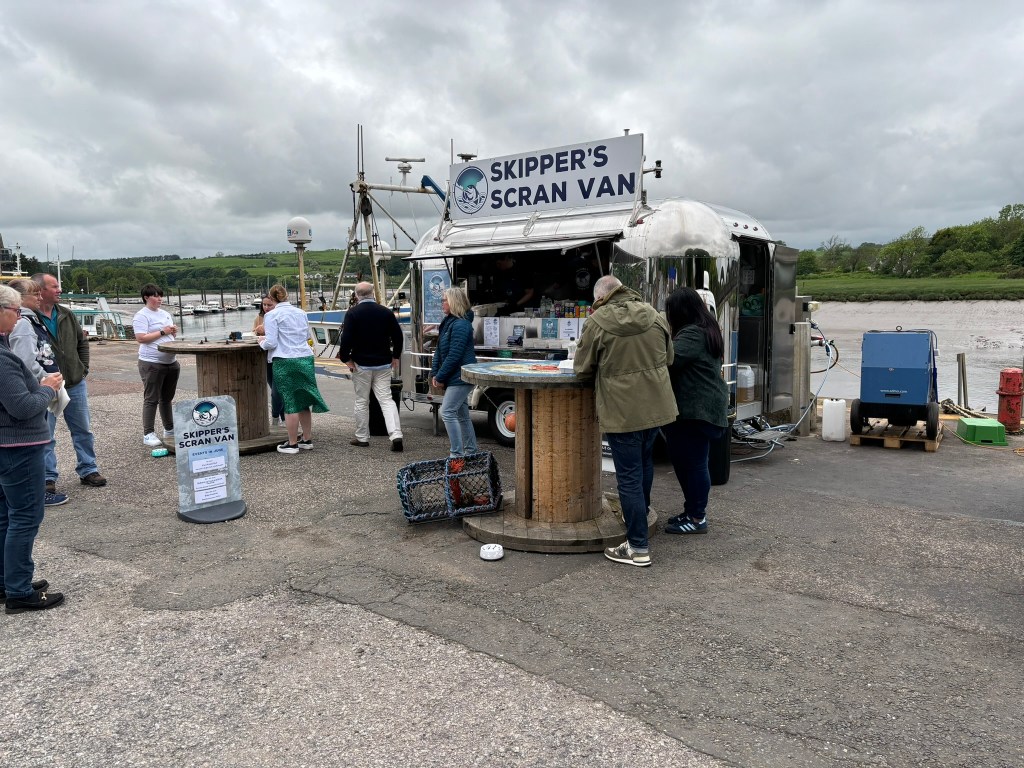
Now for value I doubt I’ll ever beat the 90p each delights on offer in Stornoway, but for around three times the price Skipper did cook them for me and serve them with chips. Surprisingly, deep frying wasn’t an option. This is The Artists’ Town, don’t you know.
Thinking of scallops I had nearly forgotten about the artists. There were posters up all over town because this is bank holiday weekend and so Kirkcubright’s Spring Fling art fair. Every studio opens its doors and puts on the coffee and the prosecco to welcome the holiday punters. This made for a very difficult morning as I couldn’t leave until lunchtime when the water came back, so I was forced to visit a few. Many were predictably awful, and made worse by having to smile and nod at the artist responsible only feet away. Others were not awful at all, but I managed to keep my credit card in my pocket for now (they all have online shops) until I came across a suitably wild black and white photograph of Muckle Flugga which – for those less obsessed than I – is the island with a lighthouse at the top of Shetland which marks the most northerly point of the UK, and will be my turning mark next year. It had been taken by an enterprising Australian who explained he had walked to the cliffs opposite in a gale for four hours with all his camera equpiment only for the heavens to open and cloud the view totally. After half an hour they cleared for five minutes, he took his photos and hiked back. It felt really presumptuous buying it before I’ve been round it, but I was there so I did. Rather superstitiously I have hidden it under my bunk with the paper charts and won’t get it out (or, hopefully, the charts) until I’ve been there. And got back safely.
Back on the boat waiting for the tide, one or two locals began to leave – either because they had shallow motor boats or were so local they knew where to go. Three polite Scottish gentlemen about my age opened up the boat next to me and prepared for what I guessed might be a bank holiday weekend without their art-loving wives. “Going anywhere nice?” I asked the skipper. “No,” he replied, “Whitehaven.” I laughed. “Ooh,” he said, “Whitehaven on a Saturday night. You’ll see things there a man should never see.” I swear I could still hear them licking their lips as they turned the corner out of sight.



 Blue Moon's trip around the UK
Leave a reply to tokarenbrown Cancel reply