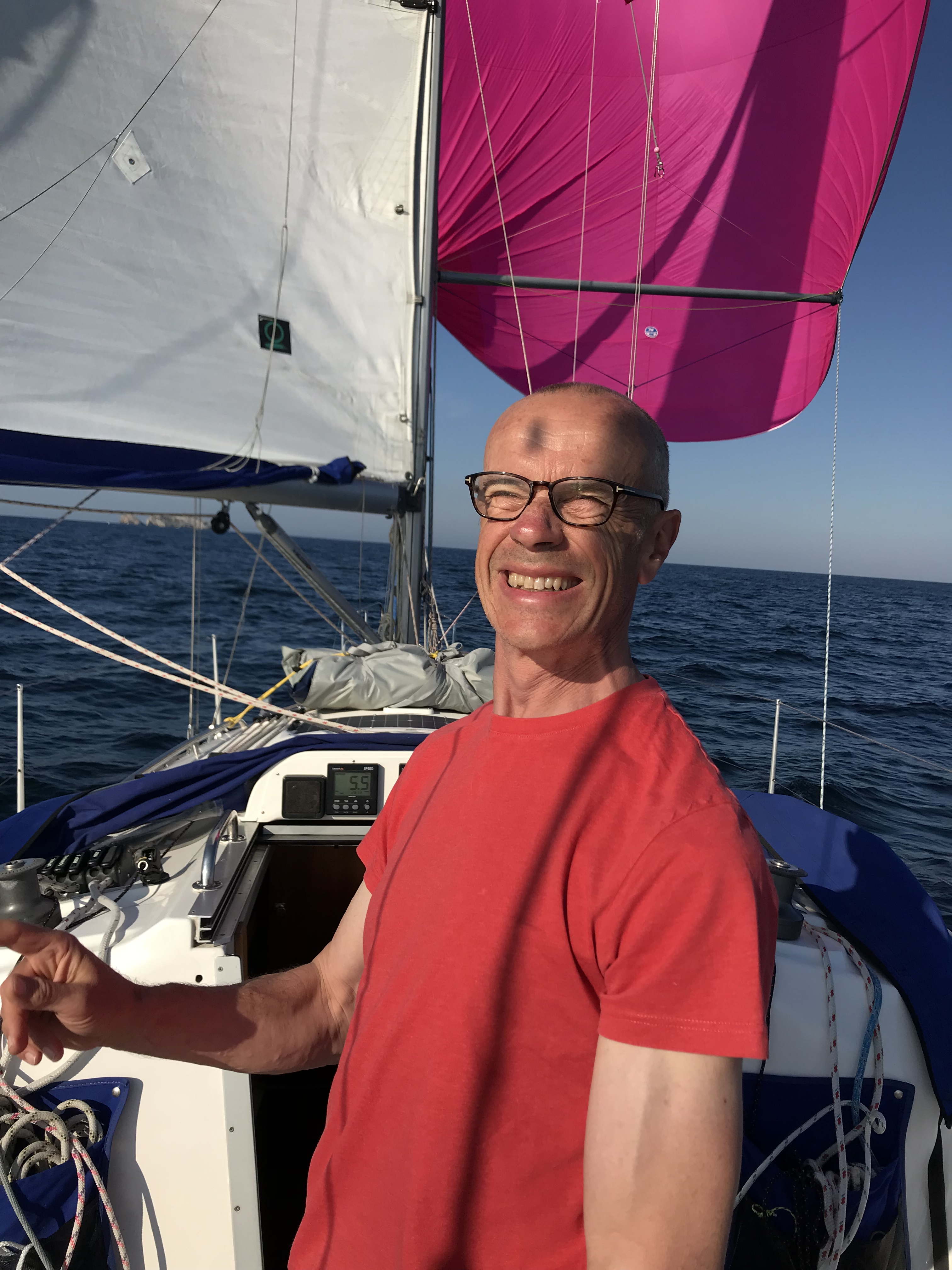
Shall we start with the festival? I know you want me to, much of the readership probably still in shock at the thought, knowing me as someone for whom Festival means more Royal and Hall than Worthy Farm.
Well, HebCelt (as the Stornoway Celtic Music Festival has rather unfortunately rebranded itself) was rather good fun. Luckily for me, a bit more 6 Music than Radio Alba, although there was a Ceilidh Tent and the occasional embittered guitarist on a stool just for authenticity. And it was exactly ten minutes’ walk from the boat, and you can’t say that about many festivals. I could even see Blue Moon through the trees. Behind the staff loos.
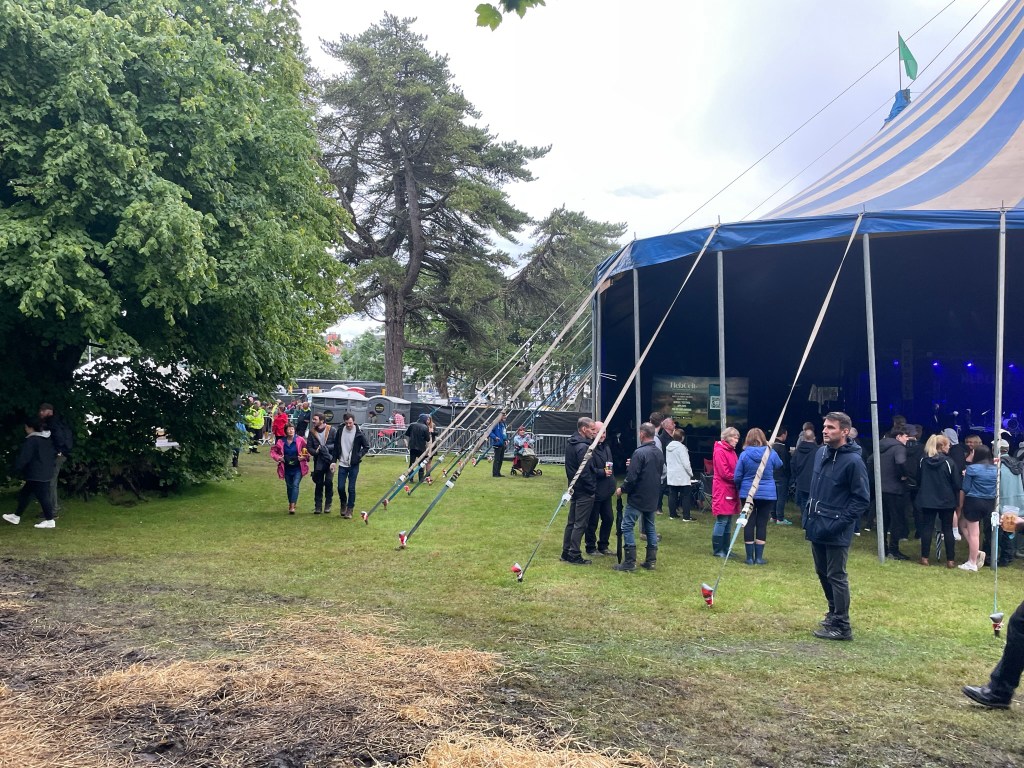
What a great site for a festival. The fish hadn’t come far either, although I suspect a ferry may have been involved for the chips and pizza
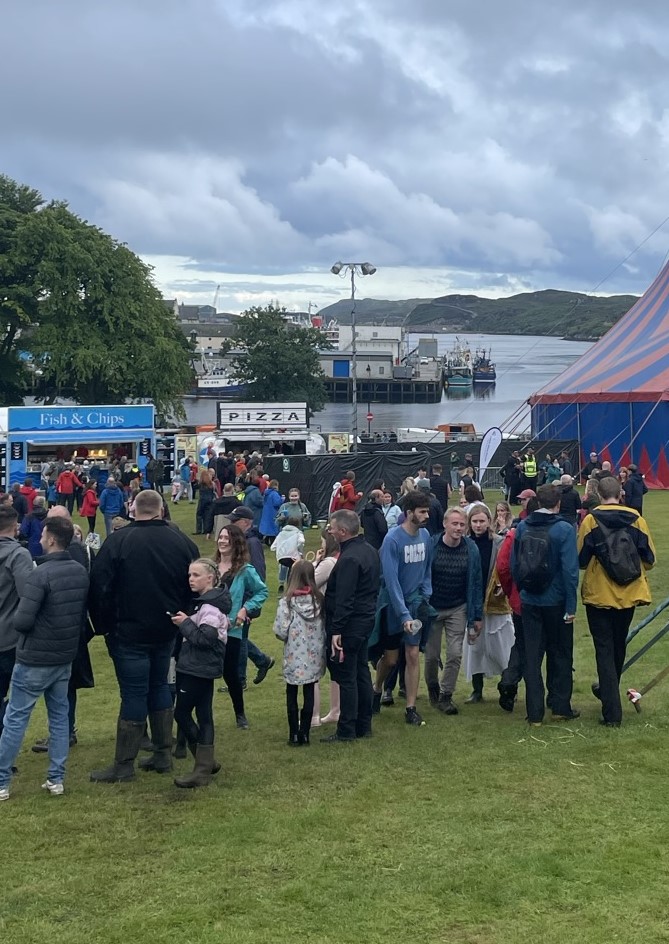
This being Stornoway it rained before, during and after so we got the full muddy field experience by 6pm on Day One. Everyone else wore wellies but I hadn’t packed for this and wasn’t going to subject my Dubarrys to a festival lavatory queue, thank you very much. It also meant that the entire audience appeared to be dressed exclusively by Mountain Warehouse, so with my boat kit I fitted right in. But the best thing about it was that no matter how morose some of the songs were, everyone was having the time of their lives, being in about equal measures diehard Celtic Music fans and locals for whom this is clearly the event of the year, and the latter were going to party as hard as possible before winter came around again next week.
I was dimly aware that Scottish/Celtic music is having a bit of a purple patch, having discovered that if you amplify violins – sorry, fiddles – and pipes loud enough you can combine them with more predictable rock instruments to make a pretty impressive and contemporary sound, and so Skerryvore (the one band I had actually heard of) proved. I never expected to enjoy a band fronted by two (yes, two) pipers, a fiddler and an accordion alongside the one guitarist, but I did, hugely. I was also relieved to find that they were the band I thought they were, having discovered that they’re named after a lighthouse off Tiree where they started, and which I had sailed past, so I could have just remembered the name from the lighthouse itself. You would probably recognise a couple of their songs but the audience knew them all, every word, and belted them out in full voice at every opportunity. I love the idea of treating bagpipes as a rock instrument: given the full Jimi Hendrix treatment the result is remarkably similar, but the pipes are a lot more visually impressive. Sadly I didn’t record the five minute pipe-wrangling solo, I was too amazed, but this gives you an idea of the fun they were having:
There were other good bands too, with (to the surprise of a Celtic Music novice) upbeat jazz and even funk takes on traditional themes. The Tumbling Souls are apparently Stornoway’s own, which probably explains (along with their infectious cheerfulness) how they got everyone dancing in mud within five minutes, and while my heart sank at the thought of having to listen to Fara – three Orcadian fiddlers (along with their friend on the keyboard) – sing and fiddle through their new album celebrating Orkney’s renewable energy initiatives (yes, that’s the one), their sheer talent was breath-taking. It was particularly noticeable how the bands and the audience had island life in common – a few of the band members came from places as dull as Glasgow, but in the main they were at pains to introduce themselves as fellow-islanders – and the folk of Lewis (and I am sure a wide range of visitors, some of whom may not live on islands) responded. So everyone, even me, went home happy, and I reckon I got home first, although getting the mud off my clothes to avoid covering the boat will have added to the time taken.
Stornoway was putting on a pretty positive view of island life throughout my visit, although I am sure it could be rather different in mid February. It is an absolutely tiny town but still manages to feel like a capital and is pretty much the only place on Lewis / Harris (confusing this: one island, two halves with different names) to come for anything other than bread and milk. It even has a Tesco, and two pubs. I found out about the pubs when the jolly Faroese chap parked next door to me mentioned that his crew were heading off to one to play at an Open Mic night, so I went along. Sadly the crew didn’t wake up in time, but the pub was rammed and a band were playing deafening covers ranging from Dolly Parton to Thin Lizzy. When I pushed past to get to the bar it turned out that it was one guy with a guitar and a tea cosy hat. Incidentally, my Faroese neighbour mentioned that he was worried that if he didn’t leave until Saturday he might be late for work on Monday morning, which made me realise just how very far North I am.
There was also plenty of Festival Fringe stuff, of which the most tempting was a workshop which promised to teach you how to offer someone a cup of tea and discuss the current midge situation in Gaelic, which is pretty much all you need in these parts (incidental note to cynics: I am yet to meet a midge in the flesh as it were; although I have invested in very expensive repellent I’ve only used it twice). But having wandered around Stornoway enough to feel I now knew every street (less than an hour), I had decided I would hire a proper bike (the folding boat bike is way too small) and cycle to see the standing stones at Calannish, referred to as the Stonehenge of Scotland. This would also allow me to have a look at Loch Roag where they’re located, and which was billed as one of the best lochs to sail to, but by far the most remote, being on the West Coast.
Then I saw the forecast, and I am sorry to say I canned the bike and for £10 more hired a Fiat 500. This was an excellent decision – not only because I spent the day in a T shirt listening to the radio and laughing every time I went past another couple of cyclists sweating up a long steady hill (of which there are many) in the latest Atlantic rainstorm (of which there were more), but also because I got to see almost all of the island, which is quite easy given that there is only really one road, but also ignores the fact that you can’t possibly see amost all of the island by car because most of it has absolutely no roads at all. It also meant that I got to Calannish in time to eat the last Malteser slice in the coffee shop, which was very unfair on the cyclists who came in behind me who deserved it more.
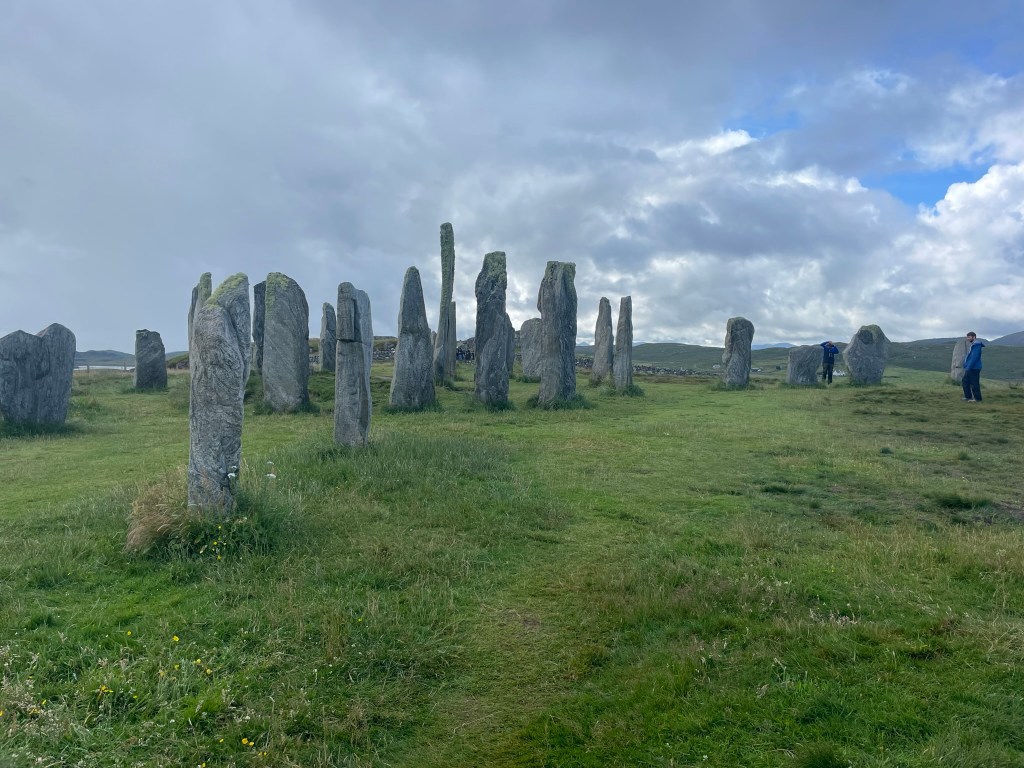
The stones were indeed impressive, and unlike Stonehenge there was no traffic din, nor any need for a tunnel. The fact that this area was more populated in 5000BC than it is now quite boggles the mind, given that this has to be one of the bleakest places I have ever been. Standing amongst the stones, with Loch Roag spread out before me and the Atlantic beyond, I could understand how prehistoric people learned to skin animals pretty smartly. I also felt quite good about my earlier decision not to spend two days dodging rocks, tides and Atlantic waves to visit Loch Roag as I’ve now done it by road, in a T shirt, with the radio on.
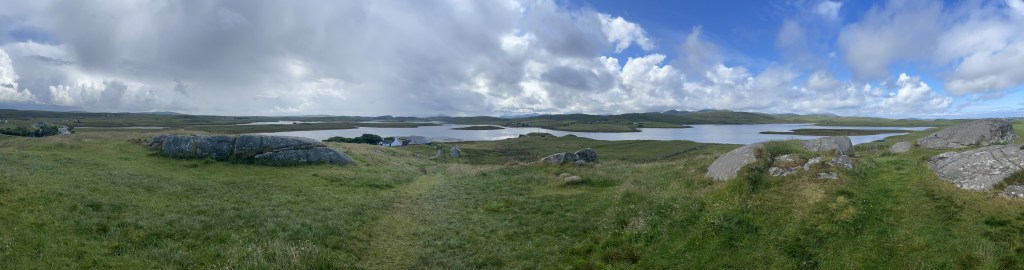
I’ve since discovered that although Lewis and Harris is the third largest island in the British Isles (i.e. the biggest that isn’t either Britain or Ireland) it has a population of just 21,000 people, more than half of whom live in Stornoway. Consequently it is absolutely empty, a fact I confirmed by driving the length of it and coming across probably fewer houses than are in my street at home. Mind you, whilst we have a decent gastropub, a very good butcher and an entertaining osteopath, we don’t have white sandy beaches…
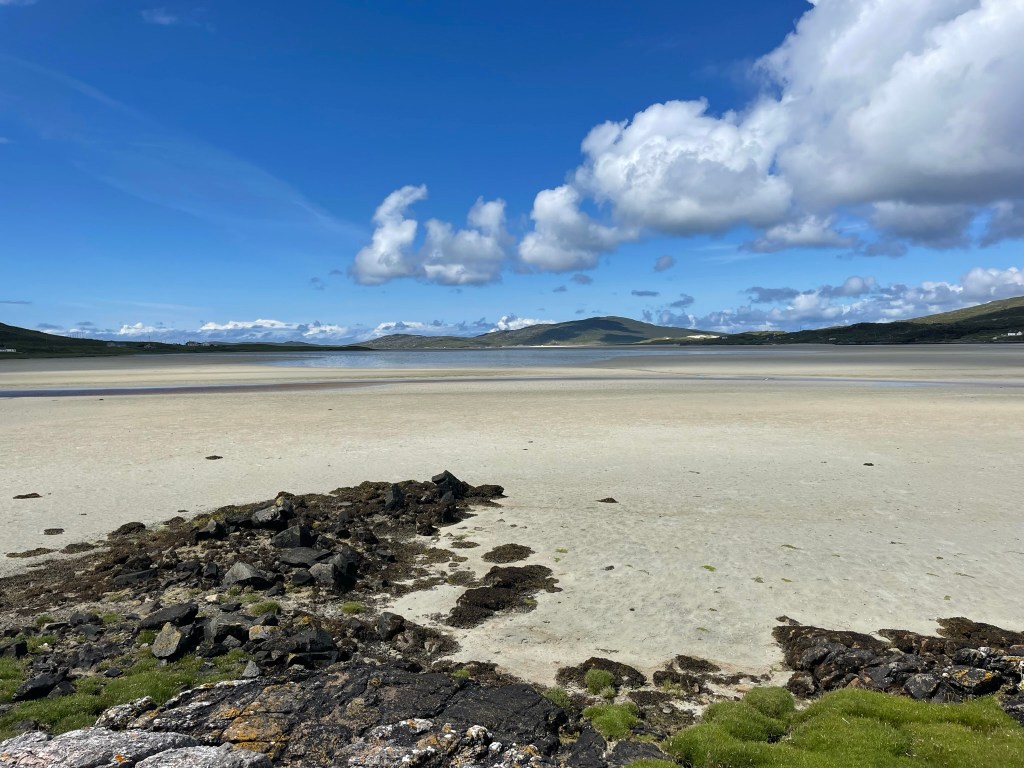
…or proper Corbett-sized mountains…
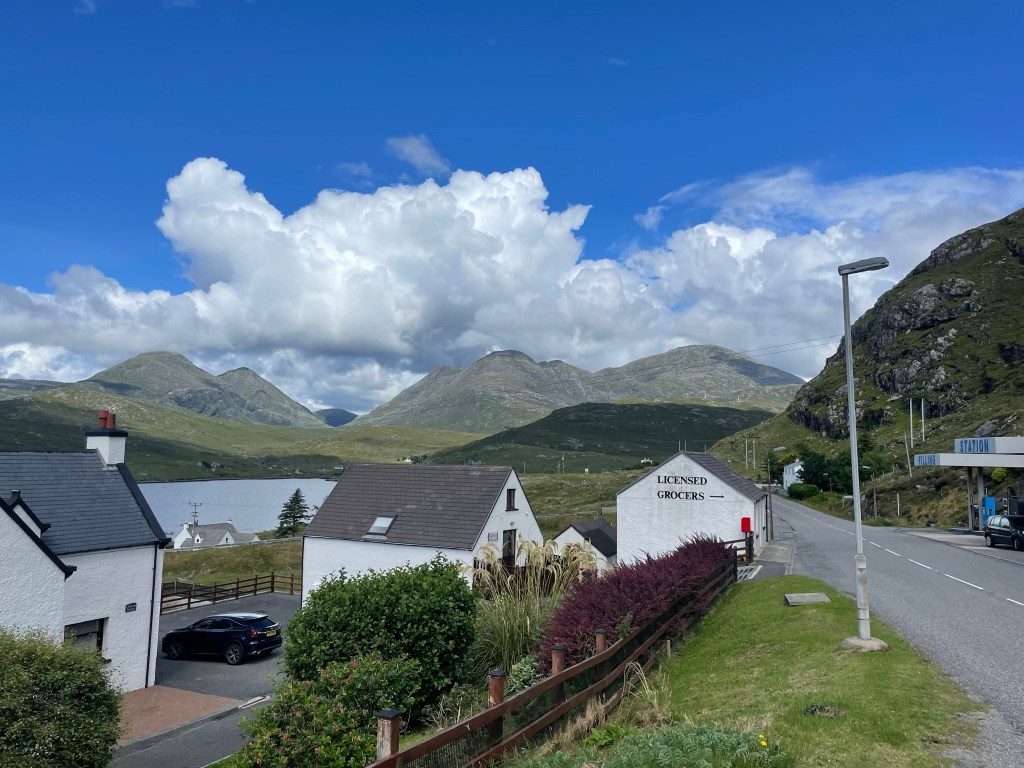
… or otters crossing the road.

Back in Stornoway, having returned the car and stocked up on black pudding and kippers (you have to admire the place for bagging the two kings of the breakfast table to be famous for) I came across this poster marking the 100th anniversary of the year that around a quarter of the young men of the Outer Hebrides, coming home from the war and seeing little future here, gave up on their islands and emigrated to Canada, taking Gaelic as a first language with them.
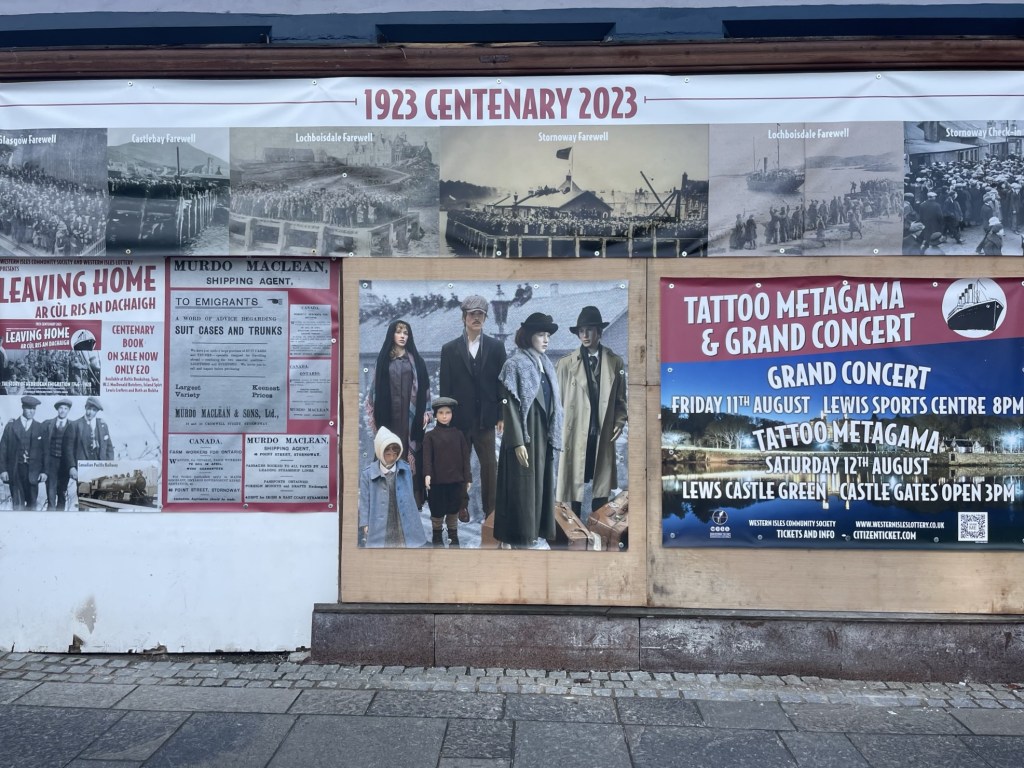
This explained the number of Canadian flags at the festival, of Canadian boats in the harbour, and the sheer, sad, emptiness of so much of the place. I’m beginning to understand why the folk that live on these far away islands-off-an-island are so proud of sticking with their island life and making the best of it they possibly can. I was heartened to read that although the population of the Outer Hebrides is still only half what it was before the mass emigrations of the twenties, it is growing again, because I really like what they have here and admire their determination to make something of it.


 Blue Moon's trip around the UK
Leave a reply to Owen Cancel reply